
Vienna to Budapest: Why Exhausted Travelers Are Abandoning the Train (And Never Looking Back)
Discover why thousands of travelers are skipping the Vienna to Budapest train and choosing a guided tour through Bratislava and Budapest instead. Less stress, zero decision fatigue, and twice the experience.
DAY TRIPS
DestinationDiscover
3/31/20265 min read
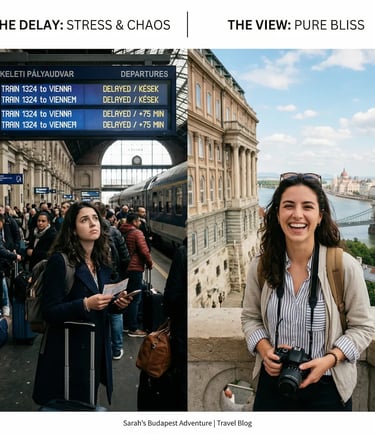
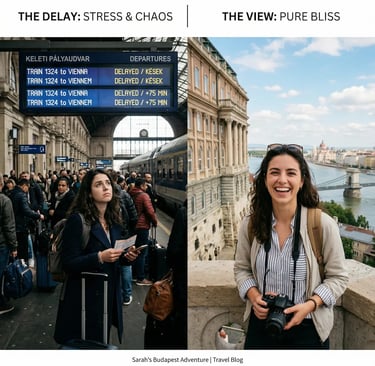
You've already made a hundred decisions today.
Which currency to carry. Which platform to stand on. Whether that departure board says Track 4 or Track 14. Whether the ticket in your hand is valid for this train or the next one. Whether you've missed your connection and if so, how bad that actually is.
This is what behavioral psychologists call decision fatigue the documented phenomenon where the quality of your choices deteriorates after a long string of mental exertion. It's not weakness. It's neuroscience. Your prefrontal cortex is simply running on fumes. And the European rail system, for all its romantic charm, is a machine specifically designed to activate every single one of those mental circuits at once.
Scenario A: The Train Experience Nobody Admits to Having
The Vienna to Budapest train vs tour debate usually starts here with someone confidently booking a rail ticket because it "seems easier."
It isn't.
You arrive at Wien Hauptbahnhof and immediately face a departure board that refreshes every 45 seconds. You're hauling luggage through a station built for locals who already know where they're going. Then comes Bratislava a connection point that sounds simple on paper but requires platform changes, schedule verification, and a working knowledge of Slovak rail customs that no travel blog prepared you for.
By the time you reach Budapest Keleti, you haven't traveled you've survived. You're dehydrated. Your back hurts. You've seen the inside of three train cars and two station bathrooms. The "highlights" of Bratislava were a 40-minute layover platform. The cities that were supposed to fill you with wonder have been reduced to stress-induced transit waypoints.
And now someone is asking you to decide where to eat dinner.
Scenario B: The Neurological Relief of Handing It All Over
A guided tour Bratislava Budapest from Vienna works on a principle that elite military and executive coaches have understood for decades: the highest performers protect their cognitive resources by eliminating unnecessary decisions entirely.
You are picked up. Climate-controlled vehicle. Door to door.
Before you've even adjusted your seat, someone is already telling you something fascinating about the Austro-Hungarian Empire a curated detail you would have had to spend 20 minutes researching yourself. Instead of decoding a schedule, you're watching the Slovakian countryside unfold through a window while a professional handles every logistical variable that would otherwise be colonizing your brain.
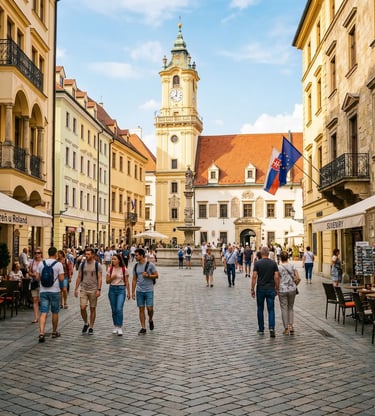
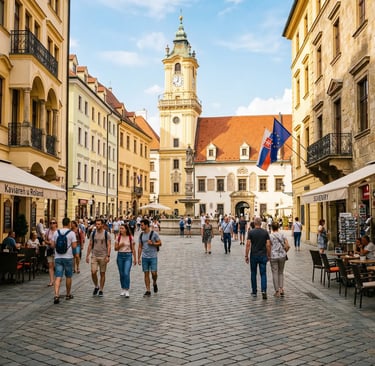
Bratislava's Old Town isn't a platform blur. It's a cobblestone square where you actually stop, look up, and feel the weight of 900 years of history. You're not calculating train times. You're present. That is a luxury that no rail ticket can sell you.
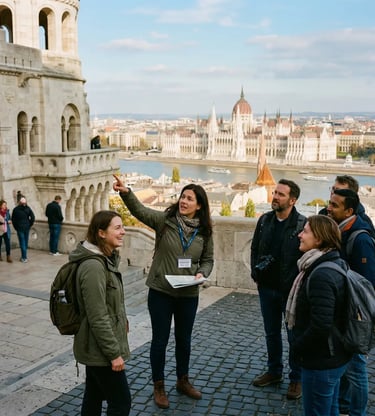
By the time you arrive in Budapest Buda Castle, the Danube promenade, the thermal bath culture your decision fatigue is at zero. You have the mental and emotional bandwidth to actually experience the city rather than simply locate yourself within it.
What the Research (and Every Returning Traveler) Will Tell You
The easiest way to see Budapest from Vienna is not the fastest route or the cheapest ticket. It's the one that costs you the least cognitively.
The Vienna to Budapest train vs tour question isn't really about transportation. It's about what kind of traveler you want to be when you arrive. Someone piecing together a journey from platform announcements and Google Maps or someone who steps out of a vehicle already knowing the three most important things about the bridge they're standing in front of.
A guided tour Bratislava Budapest doesn't just move your body between cities. It moves your attention toward what matters the architecture, the history, the food, the stories and away from the infrastructure required to get there.
You have a finite number of hours in Central Europe.
The only real question is how many of them you want to spend reading a departure board.



Frequently Asked Questions
Is it better to take the train or a guided tour from Vienna to Budapest?
For travelers who want to actually experience Central Europe rather than navigate it, a guided tour consistently outperforms the train. The Vienna to Budapest train vs tour comparison comes down to one core difference: cognitive cost. Rail travel demands constant decision-making platforms, connections, schedules, luggage management all of which drain your mental energy before you've seen a single landmark. A guided tour eliminates that friction entirely, delivering you to each destination informed, rested, and ready to absorb what you came for.
What does a guided tour from Vienna to Bratislava and Budapest actually include?
A quality guided tour Bratislava Budapest experience typically includes door-to-door private or small-group transportation, a knowledgeable guide who provides historical and cultural context throughout the journey, curated stops at the most significant landmarks in both cities, and full logistical handling so you never check a schedule or carry luggage between transit hubs. Depending on the operator, some tours also include entrance fees, restaurant recommendations, and flexible timing that no train timetable can offer.
How long does the Vienna to Budapest trip take by train versus guided tour?
The direct train from Vienna to Budapest takes approximately 2.5 to 3 hours, but this skips Bratislava entirely or reduces it to a rushed connection. A guided tour covering both Bratislava and Budapest typically spans a full day roughly 10 to 12 hours but that time is filled with meaningful experiences, not transit waiting. When you factor in station navigation, connection risks, and arrival disorientation in Budapest, the train's time advantage shrinks considerably. The tour doesn't cost you more hours it costs you fewer wasted ones.
Is a guided tour from Vienna worth it if I'm traveling on a budget?
The price gap between a rail ticket and a guided tour is real, but it rarely accounts for the hidden costs of independent travel missed connections, last-minute platform tickets, entry fees you didn't budget for, taxis from Budapest Keleti to the city center, and the meal you overpaid for because you were too exhausted to walk another block. When those variables are totaled, the guided tour Bratislava Budapest option frequently lands closer in price than most travelers expect and it delivers something a discounted rail fare never can: a day you'll actually remember.
Connect
Join us for travel tips and destination insights.
© 2026. All rights reserved.
Affiliate disclaimer
This website contains affiliate links. If you purchase through these links, we may earn a commission at no extra cost to you.