
The Floor Disappears. Your Brain Has 0.4 Seconds to Decide What's Real.
Most tourists ride the Vienna Ferris Wheel. A select few step onto Platform 9 a glass-bottom exposure 65 meters above the city that rewires your threat-detection system in real time. Here's the tactical briefing
DestinationDiscover
2/7/20266 min read
Affiliate Disclosure
This article contains affiliate links. If you purchase through these links, I may earn a small commission at no extra cost to you. I only recommend products I genuinely believe offer strong performance, quality, and value for your ski and travel experience.
You are standing on glass. Sixty-five meters below you, Vienna moves slowlycars, cobblestones, the Danube. Your rational mind knows the platform is engineered. Tested. Reinforced. But your limbic system doesn't read engineering reports.
It reads one thing: there is no floor.
And in that fraction of a second before logic catches up you will learn something about yourself that no museum, no cathedral, no guided walking tour will ever teach you.
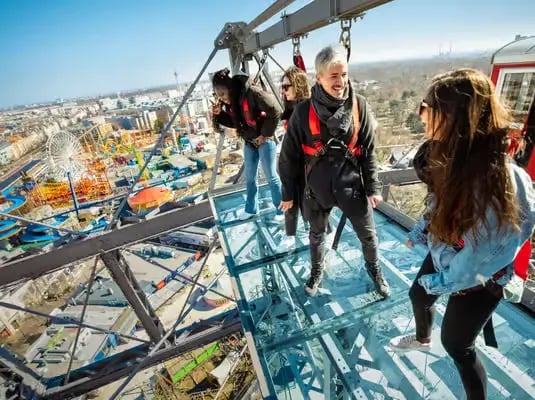
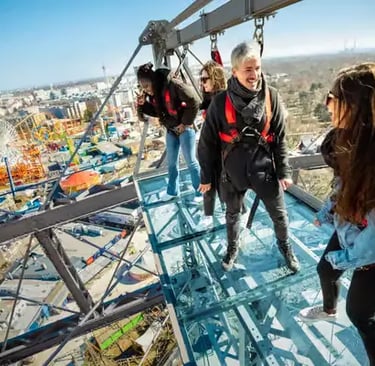
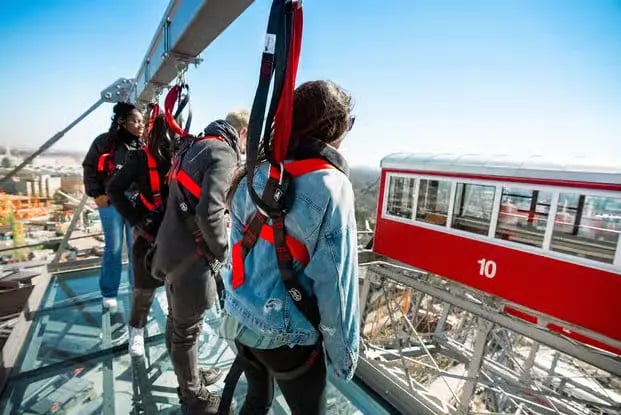
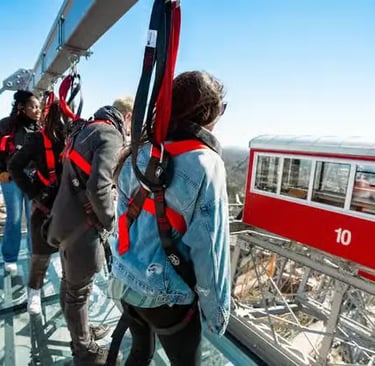
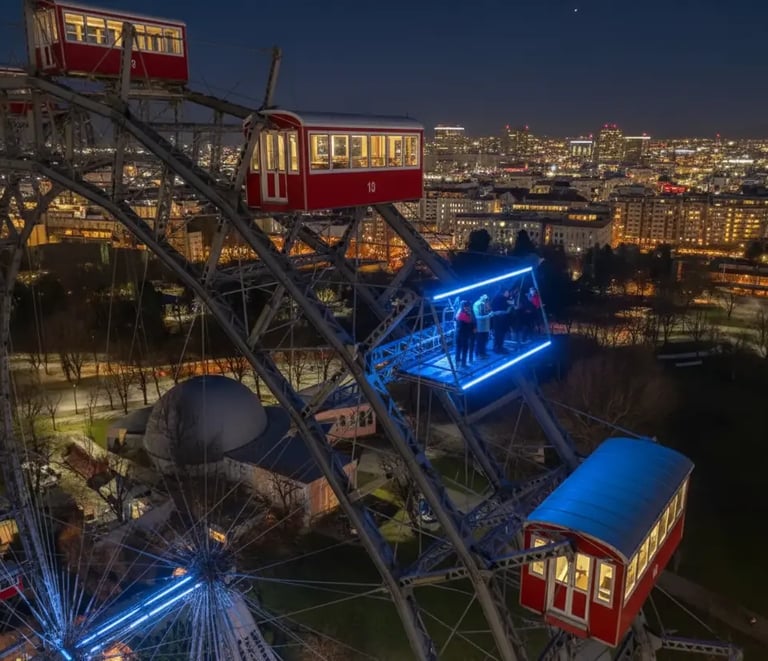
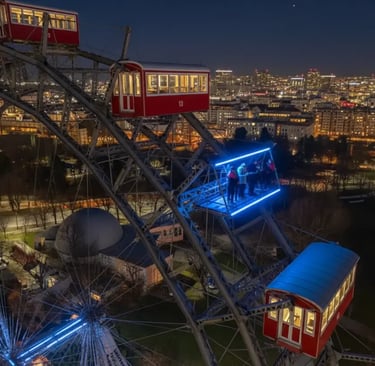
This is Platform 9 at Vienna's Riesenrad. And it is not a tourist attraction. It's a controlled perceptual disruption.
Why Your Brain Craves the Thing It Fears
There is a well-documented phenomenon in behavioral science called the "high-place phenomenon." Researchers at Florida State University identified it in 2012. It's the urge felt even by people with no suicidal ideation to jump when standing at a significant height. Not because they want to fall. Because their survival system is running a real-time conflict between two signals: danger and safety.
That conflict is what makes Platform 9 different from every other observation deck in Europe.
Most elevated viewpoints let you look out. Platform 9 forces you to look down. Through your feet. Through the floor that your proprioceptive system insists should be solid.
This is not a passive experience. It's a recalibration event. Your vestibular system the internal gyroscope in your inner ear receives contradictory data. Your eyes say open air. Your feet say solid ground. Your brain has to choose.
People pay for this. Not because they enjoy fear. Because the resolution of that conflict produces a neurochemical reward that flat ground never will.
1897 Engineering vs. Modern Nerve
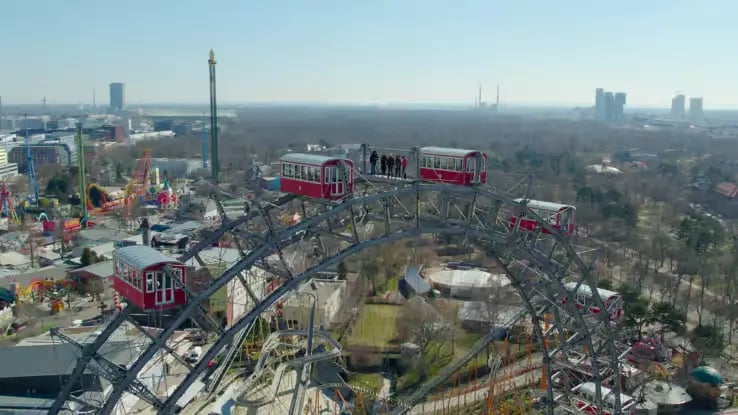
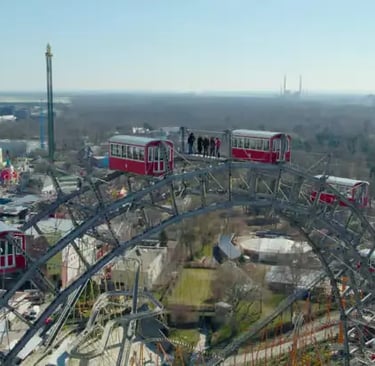
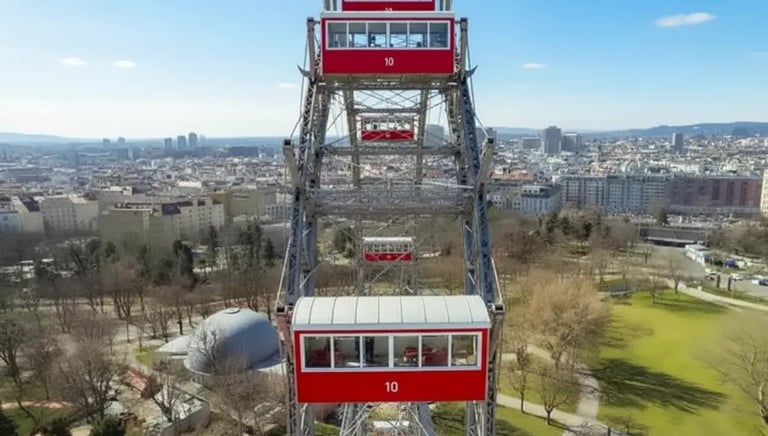
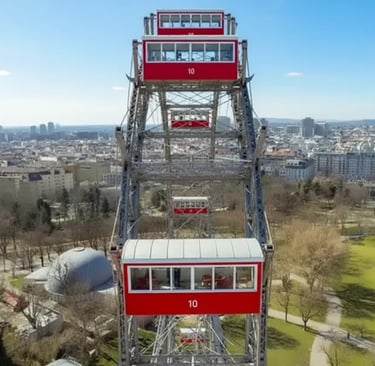
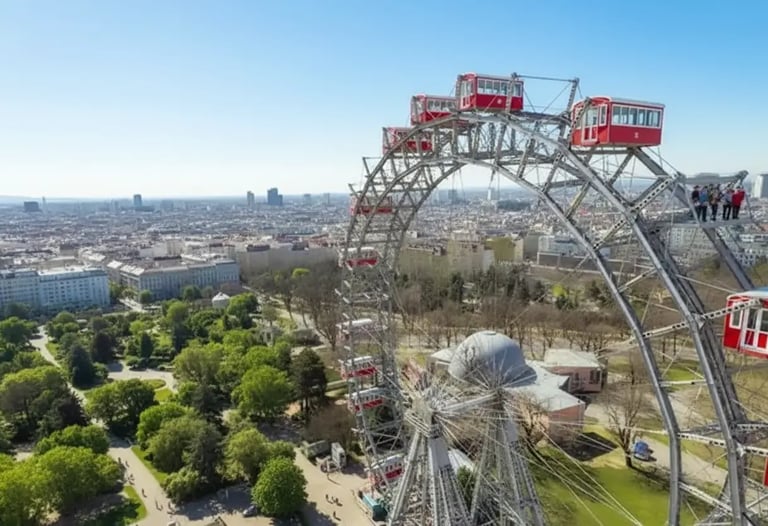
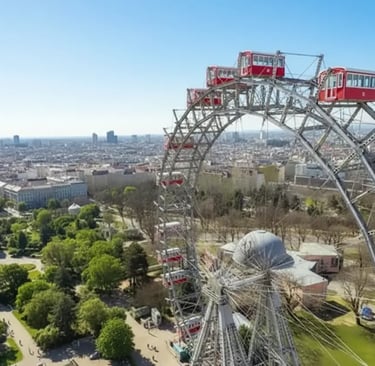
The Riesenrad was built in 1897 to celebrate Emperor Franz Joseph I's Golden Jubilee. It has survived two world wars. A fire. Structural overhauls. It has been standing over Prater Park in Vienna, Austria for over a century an iron monument to calculated risk long before the phrase existed.
The original wheel was an act of authority: empire-scale engineering designed to make citizens feel the reach of their civilization from above. Today, that authority still radiates from the structure. The iron lattice. The deliberate, unhurried rotation. Everything about the Riesenrad communicates permanence.
Platform 9 is the opposite signal.
It was installed as a modern addition a glass-bottom observation floor that strips away the one thing the original structure promised: the feeling of enclosure. The gondolas give you walls. Platform 9 gives you transparency. And transparency, psychologically, is indistinguishable from exposure.
This is what makes the experience work. The tension between a 128-year-old structure that signals safety and a modern intervention that removes it.
The Authority Figure at Sixty-Five Meters
There is an underappreciated element of the Platform 9 experience, and it has nothing to do with glass or heights.
It's the guide.
Behavioral compliance research Milgram, Cialdini, the entire corpus demonstrates that humans regulate their fear response based on the presence of a calm authority figure. A tour guide in English language narration doesn't just translate history. They function as a real-time social anchor. When someone stands beside you on a glass floor, speaking in measured tones about the structural history of the wheel, your nervous system receives a secondary signal: if they're calm, this is survivable.
This is not a small thing. It is the difference between a visceral experience and an overwhelming one. The English-speaking guide reframes the perceptual threat as a narrative converts raw sensation into structured understanding. You don't just feel the height. You process it.
What Happens on Platform 9 Sequentially
First, you ascend. The Riesenrad rotates at roughly 0.75 meters per second. Slow enough that your visual field shifts gradually. Your brain adapts in stages.
Then you step onto the platform. The glass is beneath you. The city is beneath the glass. There is a moment typically two to four seconds where your gait changes. Your steps shorten. Your center of gravity drops. This is involuntary. This is your cerebellum doing its job.
Then the perceptual shift happens. Your visual cortex accepts the depth information. Your muscles relax incrementally. You begin to look, rather than just react.
This is the part people remember. Not the fear. The moment after the fear. The recalibration. The visceral perspective that comes from standing on nothing and discovering you're still standing.
Tactical Logistics: How to Access Platform 9
If you've read this far, you're not the type who needs to be convinced. You need coordinates.
Location: Riesenrad, Prater Park, Vienna, Austria. Accessible via U1/U2 to Praterstern station.
Booking: Most reputable ticket platforms offer free cancellation, which eliminates commitment friction. Several also allow you to book now, pay later removing the last psychological barrier between decision and action.
Language: English-language guided experiences are available and recommended. As outlined above, the guide isn't a luxury; they're a functional component of the experience itself.
Timing: Early evening provides the optimal dual-light condition natural and artificial illumination from below. This maximizes the depth perception effect on the glass platform.
Duration: The full rotation takes approximately 15–20 minutes. Platform 9 access is typically included in premium ticket packages.
The Trial Close
Here's what happens if you skip this.
You visit Vienna. You see Schönbrunn. You eat Sachertorte. You walk the Ringstrasse. You leave with photographs that look like everyone else's photographs.
Or you stand on a glass floor at sixty-five meters and experience a perceptual event that your nervous system will catalog differently from every other memory you form on that trip.
One of those experiences changes the way you process risk. The other is tourism.
The Riesenrad isn't going anywhere. It's been here since 1897. But your window for experiencing it with the guide, with the glass, with the neurochemistry that only fires when the floor disappears exists only in the version of yourself willing to book it.
Free cancellation means the only cost of deciding is zero.
The cost of not deciding is the experience itself.
FAQ Section
Q1: What is Platform 9 at the Vienna Riesenrad?
Platform 9 is a glass-bottom observation floor on the Vienna Giant Ferris Wheel (Riesenrad) in Prater Park, Vienna, Austria. Unlike the traditional enclosed gondolas, Platform 9 places you on a transparent surface 65 meters above the city creating a direct visual exposure to the ground below. It is designed as a premium sensory experience, not just a sightseeing stop.
Q2: Is the glass floor on the Vienna Ferris Wheel safe?
Yes. The glass panels on Platform 9 are engineered to withstand loads far exceeding the maximum visitor capacity. The Riesenrad itself has been operational since 1897 and undergoes continuous structural inspections. The perceived danger is a neurological response your vestibular system reacting to contradictory sensory input not a structural risk.
Q3: Can I book Platform 9 tickets with free cancellation?
Most major booking platforms offer Platform 9 and Riesenrad tickets with free cancellation. Several also provide a book now, pay later option, so you can secure your time slot without upfront payment and cancel without penalty if your plans shift.
Q4: Is there an English-speaking guide on Platform 9?
Yes. English-language guided experiences are available for the Riesenrad and Platform 9. The tour guide in English language provides historical context about the wheel's 1897 origins and narrates the experience in real time which, beyond information, serves as a psychological anchor that helps regulate the fear response at height.
Q5: What is the best time to visit Platform 9 on the Riesenrad?
Early evening during the transition between natural daylight and the city's artificial illumination. This dual-light window maximizes the depth perception effect through the glass floor. The contrast between the lit cityscape below and the fading sky amplifies the visual exposure that makes Platform 9 distinct from standard observation points.
Q6: How long does the Vienna Giant Ferris Wheel ride take?
A full rotation of the Riesenrad takes approximately 15 to 20 minutes. Platform 9 access is typically included in premium ticket packages and can be experienced before or after the gondola rotation, depending on the specific tour format you book.
Q7: How do I get to the Riesenrad in Vienna?
The Riesenrad is located in Prater Park, Vienna, Austria. The most direct route is via the Vienna U-Bahn: take line U1 or U2 to Praterstern station. The wheel is visible from the station exit less than a five-minute walk.
Connect
Join us for travel tips and destination insights.
© 2026. All rights reserved.
Affiliate disclaimer
This website contains affiliate links. If you purchase through these links, we may earn a commission at no extra cost to you.