
The Only Dalmatian Speedboat Route Worth Your Time: Split to Hvar via Five Unignorable Stops
Private speedboat tour from Split or Trogir covering five essential stops: Blue Cave on Biševo, Vis Island and Komiža, Stiniva Bay, Budikovac Blue Lagoon, and Hvar Town with Španjola Fortress. A single-day route engineered for sequence, geography, and maximum impact across the Dalmatian coast.
DAY TRIPS
DestinationDiscover
5/12/20266 min read
Most travelers make the same mistake along the Croatian coast. They board a crowded catamaran, sit in recycled air for ninety minutes, arrive at one island, and call it a day. That is not exploration. That is transportation with a view.
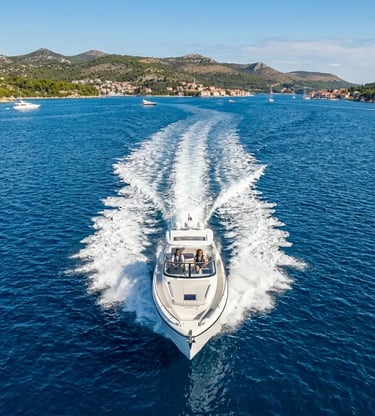
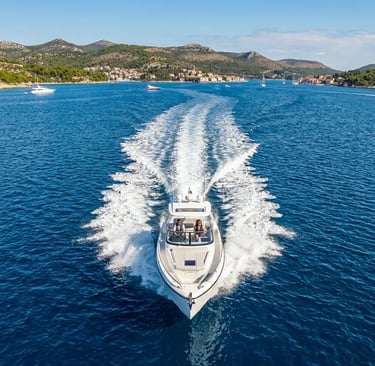
A private or small-group speedboat departing from Split or Trogir rewrites the entire equation. You cover five distinct locations in a single day, each one selected for a specific reason, each one inaccessible by standard ferry. The route runs south from the mainland to the remote island of Biševo, loops through Vis and its surrounding bays, and finishes at Hvar. There is no backtracking. There is no wasted time. Every nautical mile earns its place on the itinerary.
Stop One: The Blue Cave, Biševo Island
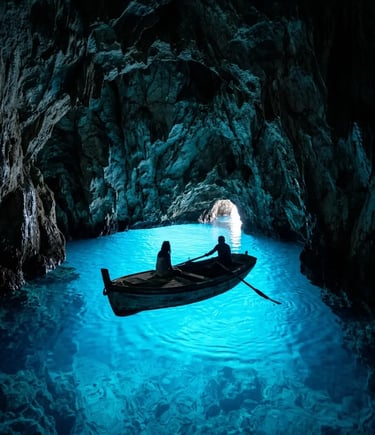
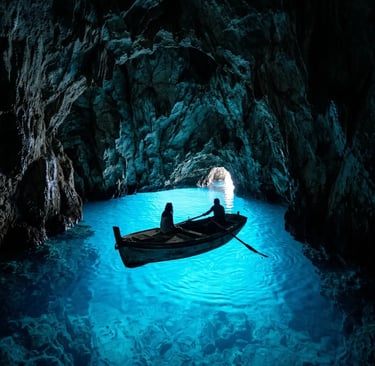
Biševo sits sixteen kilometers off the southwest coast of Vis. The island has a permanent population that rarely exceeds fifteen people. You are not here for the island. You are here for a sea cave with a submerged entrance that refracts sunlight between 9:30 and 11:30 in the morning, turning the interior water an electric, almost synthetic blue. The phenomenon is geological, not decorative. Limestone walls, a specific depth of white sand on the cave floor, and a precise angle of solar entry produce the effect. You enter by small boat. You stay for roughly ten minutes. The visual information your brain receives in that window does not match anything in your existing memory. That is the point.
Stop Two: Vis Island and Komiža
Vis operated as a closed Yugoslav military base until 1989. Civilian access did not exist. That enforced isolation preserved the island in a condition most of the Adriatic lost decades ago. Komiža, the fishing village on the western coast, remains functionally unchanged. Narrow stone lanes, active fishing boats, no franchise signage. Parts of Vis also served as the filming location for the 2018 adaptation of Mamma Mia! Here We Go Again, though the island's actual history is far more compelling than any screenplay.
Stop Three: Stiniva Bay
Stiniva is a cove on the southern face of Vis, enclosed by two vertical cliff walls that converge to form a natural gateway barely ten meters wide. Beyond that gap, the pebble beach and calm water are almost entirely concealed from open sea. The formation earned European Best Beach designation in 2016. Access by land requires a steep trail. Access by speedboat requires a skilled captain and the right hull size. This is a location that filters its own visitors.
Stop Four: Budikovac Island and the Blue Lagoon
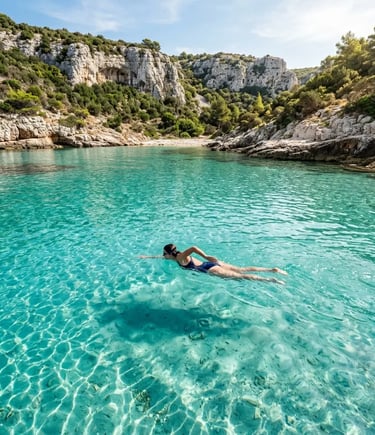
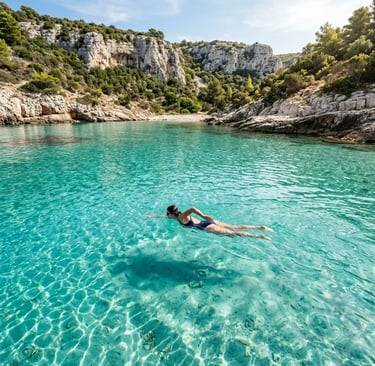
Budikovac is a small, uninhabited island east of Vis. The surrounding shallows create a lagoon with water so transparent that boats appear to hover above the seabed. Depth here ranges from one to four meters over white sand. You swim. You anchor. You exist in a place that has no infrastructure, no vendors, and no noise beyond water against rock. The value is not in what Budikovac offers. The value is in what it refuses to include.
Stop Five: Hvar Town and Španjola Fortress
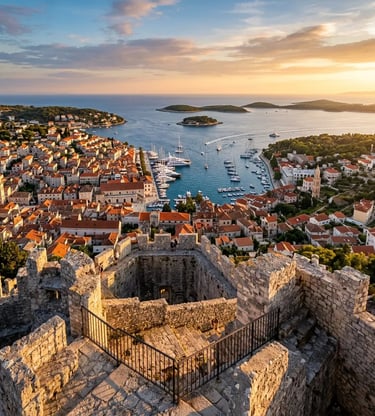
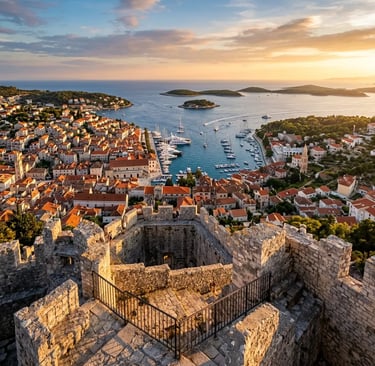
Hvar requires no introduction, but it does require correct framing. Most visitors remain at the harbor, surrounded by yachts and cocktail menus. The superior move is vertical. Španjola Fortress sits above the town, built by the Venetians in the sixteenth century and expanded by the Austrians in the nineteenth. The climb takes fifteen minutes. From the top, you see the Pakleni Islands, the open Adriatic, and the full geometry of Hvar's terracotta grid below you. The fortress provides the single best vantage point on the entire Dalmatian coast. It is also the ideal place to process the preceding eight hours of sensory input.
The Operational Truth
This route works because it respects sequence, geography, and the psychology of experience. You begin with the most remote and visually disorienting location while your attention is sharpest. You end at an elevated position with a drink in your hand and a view that contextualizes everything you just did. The boat is not the attraction. The boat is the mechanism that makes five incompatible locations behave like a single, coherent narrative.
Frequently Asked Questions About the Split to Hvar Speedboat Tour
How long does the full five-stop speedboat tour take?
The complete route from departure at Split or Trogir through all five stops to the final drop-off in Hvar Town requires approximately eight to ten hours. This is not a rushed schedule compressed to check boxes. Each location receives dedicated time calibrated to its purpose, whether that means ten focused minutes inside the Blue Cave or ninety minutes anchored at the Blue Lagoon near Budikovac.
Transit time between stops varies depending on sea conditions, but the speedboat format eliminates the dead hours that plague ferry-based itineraries. You move between islands at thirty to forty knots. You are never sitting idle. The captain manages the clock so you arrive at Hvar in late afternoon with enough daylight to climb Španjola Fortress and process the full trajectory of the day.
Morning departure typically falls between 8:00 and 9:00 AM. This is non-negotiable if you want correct light conditions inside the Blue Cave on Biševo. The timing architecture of the entire route depends on hitting that first stop within the optimal solar window.
What is the best time of year to take this tour?
The operational season runs from May through October. June and September represent the two highest-value months. Water temperature in June sits between 21 and 23 degrees Celsius, warm enough for extended swimming at Stiniva and Budikovac without the crowd density of July and August. September offers similar thermal conditions with reduced boat traffic across the entire Vis archipelago.
July and August are functional but congested. The Blue Cave on Biševo operates a queuing system during peak season, and wait times can exceed forty-five minutes. A private speedboat mitigates this by allowing the captain to adjust the sequence or arrive before the tour-bus boats launch from Komiža. That tactical flexibility is one of the primary reasons the private format outperforms group excursions during high season.
May and October carry higher weather risk. The Adriatic can produce southerly winds that close the Blue Cave entrance entirely. If Biševo is your primary objective, book during the June-to-September corridor and confirm cave accessibility with your operator twenty-four hours before departure.
Is the Blue Cave on Biševo worth the extra distance?
Biševo sits further from the mainland than any other stop on this route. Reaching it adds roughly forty minutes of open-water transit each direction. That investment is justified by a single fact: no other location on the Adriatic produces the same optical phenomenon. The cave's submerged entrance channels sunlight through seawater onto a white sand floor, generating a blue luminescence that appears artificial but is entirely geological.
The experience inside the cave lasts approximately ten minutes. That brevity is intentional. The small transfer boats cycle groups through efficiently, and the visual impact does not require extended exposure. Your brain registers the color anomaly within seconds. Everything after that is confirmation.
Skipping Biševo to save transit time is a miscalculation. The Blue Cave functions as the perceptual anchor of the entire itinerary. It recalibrates your visual baseline so that every subsequent stop, from Stiniva's cliff corridor to Budikovac's transparent shallows, registers with sharper contrast. Remove it, and the remaining four stops lose their sequencing logic.
What should I bring on the speedboat tour?
Pack for function, not fashion. The essentials reduce to five categories: sun protection, water access, footwear, layering, and documentation. A high-SPF reef-safe sunscreen is mandatory. You will spend eight hours under direct Mediterranean sun with saltwater reflection amplifying UV exposure from below. Reapply every ninety minutes without exception.
Footwear matters more than most travelers anticipate. Stiniva Bay has a pebble beach that punishes bare feet. The climb to Španjola Fortress in Hvar covers uneven stone steps. Bring water shoes for beach stops and a pair of light sneakers or sport sandals with grip for the fortress ascent. Flip-flops are inadequate for both scenarios.
Bring a dry bag for your phone and documents. Speedboats generate spray, and open-water crossings between Vis and Hvar can produce genuine chop. A light windbreaker serves double duty as morning insulation during early crossings and protection against late-afternoon wind on the return. Towels, snorkeling gear, and drinking water are typically supplied by the operator, but confirm inventory before boarding.
Connect
Join us for travel tips and destination insights.
© 2026. All rights reserved.
Affiliate disclaimer
This website contains affiliate links. If you purchase through these links, we may earn a commission at no extra cost to you.