
The Neuroscience of Desire: Why Your Brain Was Engineered to Need a Private Wooden Boat on Lake Como
Discover the psychology of exclusivity behind a private historic wooden boat tour on Lake Como. Explore how conscious authenticity, narrative identity, and Riva heritage craft the ultimate bespoke luxury travel experience from Como to Villa d'Este.
DAY TRIPS
DestinationDiscover
5/10/20266 min read
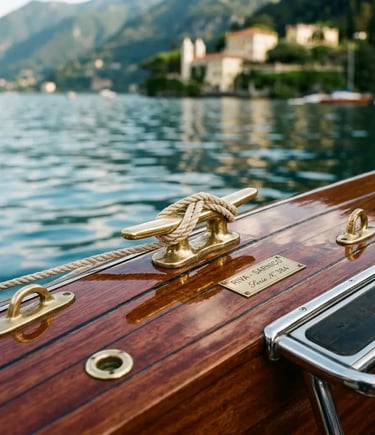
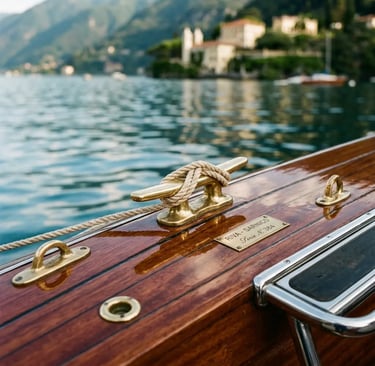
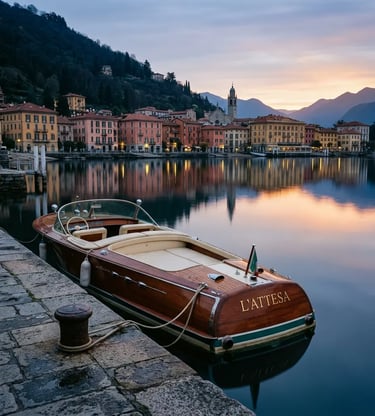
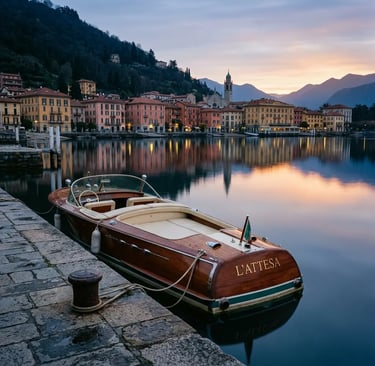
There is a moment and you have already experienced it when you encounter something so precisely calibrated to your deepest psychological wiring that resistance becomes biologically futile. This is not aspiration. This is recognition. The private historic wooden boat tour of Lake Como, departing from the stone-lined shore of Lungo Lario Trieste 28, is not a vacation activity. It is an identity event. And your nervous system already knows it.
What separates the individuals who book bespoke luxury travel on Lake Como from those who simply admire it from a screen is not wealth. It is a neurological threshold. The moment you recognized the silhouette of a handcrafted wooden vessel echoing the unmistakable Riva heritage of mid-century Italian naval design your brain executed a status-appraisal sequence older than language itself. The ventromedial prefrontal cortex fired. Dopaminergic reward pathways activated. You did not choose to want this. Your biology chose for you.
The Psychological Architecture of Lake Como Navigation
Self-Determination Theory, the most rigorously validated framework in motivational psychology, identifies three non-negotiable human needs: autonomy, competence, and relatedness. A private wooden boat tour on Lake Como satisfies all three with surgical precision, which is why the experience produces a psychological resonance that no group excursion, no hotel concierge recommendation, and no algorithmic travel suggestion can replicate.
Autonomy is the first pillar. The act of commissioning a private departure — selecting the hour, dictating the route, controlling the pace of your own narrative — separates the traveler from the tourist at a neurological level. Tourists surrender agency. Travelers assert it. When you board a historic wooden boat at a specific coordinate on the Como waterfront, you are not joining an itinerary. You are authoring one. This is the invisible layer of luxury that mass-market operators cannot manufacture.
Competence, the second pillar, emerges through connoisseurship. Understanding why a hand-restored wooden hull matters, why the grain of mahogany reflects a century of Italian artisan tradition, why Riva heritage is not a brand but a behavioral signal this knowledge functions as a psychological credential. It communicates to others, and more critically to yourself, that you possess the perceptual depth to distinguish the authentic from the merely expensive. This is conscious authenticity in its purest operational form: the deliberate selection of experience over exhibition.
Relatedness, the third pillar, is fulfilled not through crowds but through curated intimacy. The private nature of the vessel transforms every passenger into a principal, not a participant. Narrative identity the story you construct about who you are demands scenes of consequence, not filler.
Behavioral Trigger Points Along the Como Waterline
The itinerary itself is an exercise in psychological sequencing. Each stop activates a distinct layer of the high-status experiential profile:
Departure from Lungo Lario Trieste 28, Como — The specificity of the departure point triggers what behavioral analysts call "coordinate anchoring." A named address, not a generic dock, signals insider access. Your brain categorizes this as earned knowledge, elevating perceived competence and psychological exclusivity before the engine turns over.
The private swimming stop at Villa Pliniana — Privacy is the ultimate modern luxury because it cannot be algorithmically distributed. Swimming in the shadow of a sixteenth-century villa, invisible to the public gaze, satisfies a primal territorial instinct. The water is not simply water. It is a boundary between your experience and everyone else's absence from it.
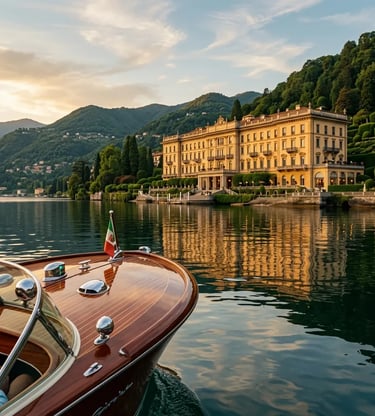
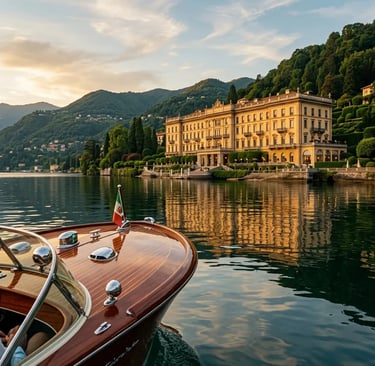
The approach to Villa d'Este, Cernobbio — Villa d'Este has functioned as a dominance signal for European aristocracy since 1568. Approaching it from the water aboard a historic wooden boat replicates the exact perceptual frame of the individuals who built it: arrival by vessel, not by road. This is not sightseeing. It is behavioral alignment with five centuries of encoded power.
The Diagnostic Conclusion
Your attraction to this experience is not whimsical. It is a predictable biological response to high-status stimuli that your conscious mind is now rationalizing as "interest." The internal tension you feel the gap between knowing this experience exists and not yet having claimed it is a textbook open loop in your psychological narrative. Bespoke luxury travel on Lake Como aboard a historic wooden boat is not an indulgence. It is the resolution. The only remaining variable is whether you close the loop or allow it to persist, unresolved, as evidence of a story you failed to finish writing.
The boat is real. The departure point is fixed. The question was never whether you wanted this. The question is whether you will act consistently with the identity you already hold.
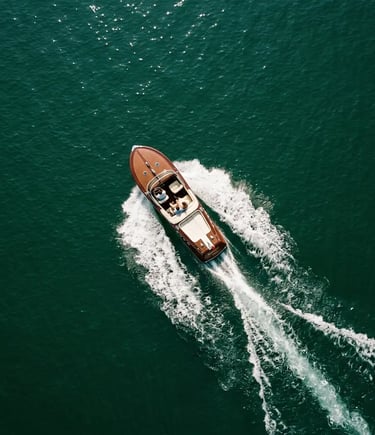
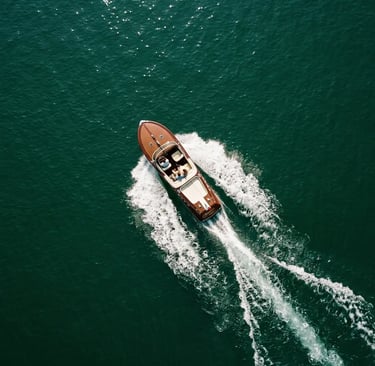
Frequently Asked Questions About the Psychology of Luxury Travel on Lake Como
Why does a private wooden boat on Lake Como feel more meaningful than other luxury experiences?
The sensation of heightened meaning is not subjective preference. It is a neurological outcome driven by environmental specificity. Lake Como's geography narrow glacial water enclosed by vertical terrain — produces a perceptual compression effect. Your visual field narrows, ambient noise drops, and the brain shifts into a state of focused presence rarely achieved in open-landscape destinations.
A private historic wooden boat intensifies this effect by removing social performance demands. Without strangers to manage or group dynamics to navigate, the prefrontal cortex redirects cognitive resources from social monitoring to sensory absorption. You are not performing relaxation. You are neurologically experiencing it at a depth most resort environments cannot access.
This is why travelers consistently describe the experience using language associated with identity rather than entertainment. Words like "transformative" and "defining" replace "fun" and "nice" because the psychological event is categorically different from leisure consumption. The brain encodes it as autobiography, not activity.
What makes Riva heritage boats psychologically different from modern luxury vessels?
Modern luxury yachts signal financial capacity. A hand-restored wooden boat with Riva heritage signals temporal depth, connoisseurship, and cultural literacy simultaneously. These are fundamentally different behavioral communications, and the human brain evaluates them through separate neural pathways.
Material authenticity activates the same perceptual systems that assess trustworthiness in human faces. Genuine aged mahogany, hand-fitted brass hardware, and visible craftsmanship evidence trigger an unconscious appraisal of integrity. The brain reads honest materials the way it reads honest expressions — with reduced skepticism and increased reward activation.
This is the operational core of conscious authenticity in luxury travel. The vessel itself functions as a credential, communicating that the individual aboard possesses the perceptual sophistication to choose heritage over novelty. In behavioral profiling, this single choice reveals more about psychological maturity than any other consumer decision in the travel category.
How does the concept of narrative identity apply to bespoke luxury travel on Lake Como?
Narrative identity is the psychological framework through which every human constructs a coherent life story. We do not remember experiences in isolation. We encode them as chapters that either confirm or elevate the protagonist we believe ourselves to be. Bespoke luxury travel on Lake Como provides what psychologists call a "high-fidelity scene" an episode rich enough in sensory and emotional detail to anchor an entire identity chapter.
The specific itinerary architecture matters enormously here. Departing from a named coordinate, swimming privately beside a sixteenth-century villa, and approaching Villa d'Este by water are not random stops. They are narrative nodes, each one providing the traveler with a scene that carries symbolic weight far beyond its duration.
Tourists collect locations. Travelers with developed narrative identity collect scenes of psychological consequence. The distinction is not philosophical. It is measurable in how the memory is stored, how frequently it is recalled, and how powerfully it shapes subsequent decision-making about who you are and what you require from life.
Is the desire for psychological exclusivity a learned behavior or a biological response?
It is both, but the biological architecture is primary. Status-appraisal circuitry is present in every social species on Earth. Humans did not invent the desire for exclusive access. Evolution installed it as a survival advantage millions of years before the first wooden boat touched water.
What culture and learning contribute is refinement of the signal. An untrained eye sees a boat. A psychologically developed individual sees a Riva-heritage vessel, recognizes the craftsmanship lineage, understands the behavioral signal it transmits, and experiences a dopaminergic reward proportional to that depth of recognition. Education does not create the desire. It sharpens the resolution at which the desire operates.
This is precisely why psychological exclusivity cannot be manufactured through price inflation alone. Expensive is not exclusive. Exclusivity requires layers of meaning that reward perceptual depth — historical context, material authenticity, geographic specificity, and controlled access. The private wooden boat tour on Lake Como satisfies every criterion simultaneously, which is why the neurological response it produces is disproportionately powerful relative to its cost.
Connect
Join us for travel tips and destination insights.
© 2026. All rights reserved.
Affiliate disclaimer
This website contains affiliate links. If you purchase through these links, we may earn a commission at no extra cost to you.