
The Definitive Matera to Alberobello, Locorotondo & Polignano a Mare Day Trip: A Strategic Route Through Southern Italy's Most Concentrated Corridor of Beauty
Discover the ultimate Apulia day trip from Matera to Alberobello, Locorotondo & Polignano a Mare. Cross from Basilicata into Puglia's UNESCO Trulli, Valle d'Itria hilltops & Adriatic cliffs in one guided route.
DAY TRIPS
DestinationDiscover
5/31/20266 min read
Southern Italy's most rewarding single-day itinerary begins in the ancient cave city of Matera and cuts east through three of the most architecturally distinct towns on the Mediterranean. This Apulia day trip covers approximately 150 kilometers of terrain that transitions from the raw, lunar gorges of Basilicata into the cultivated elegance of Puglia and it does so with a density of visual and cultural payoff that no other route in the region can match.
Leaving the Sassi: The Cross-Regional Corridor From Matera Into Puglia
The route departs Matera and crosses from the Basilicata region into the Apulia (Puglia) region within the first hour. This is not a minor geographic detail. The two regions share a border but almost nothing else — the landscape shifts from arid, pale ravines to the rolling olive groves and dry-stone walls of the Valle d'Itria with startling speed. A private transfer from Matera eliminates the single greatest friction point of this journey: the near-total absence of efficient public transit connecting these destinations. There is no direct train. Bus schedules are unreliable and misaligned. The roads between these towns are narrow, poorly signed, and governed by local driving customs that reward familiarity over GPS confidence.
This is the logistical reality that most travel content omits. A guided Valle d'Itria tour with integrated transport is not a luxury add-on. It is the baseline infrastructure required to experience these three towns in a single day without losing hours to navigation, parking, and route recalculation.
The Architectural Psychology of Alberobello and Locorotondo
Alberobello: UNESCO-Protected Geometry
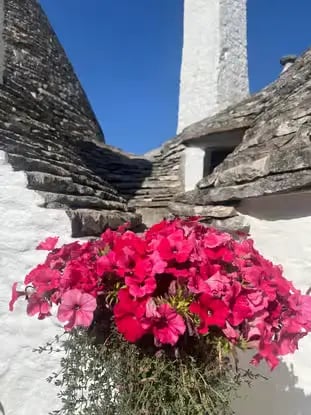
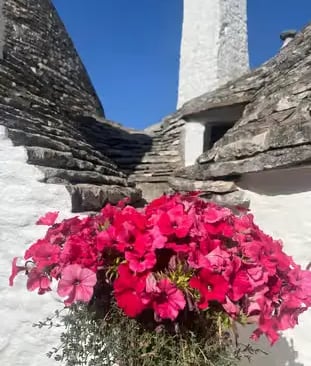
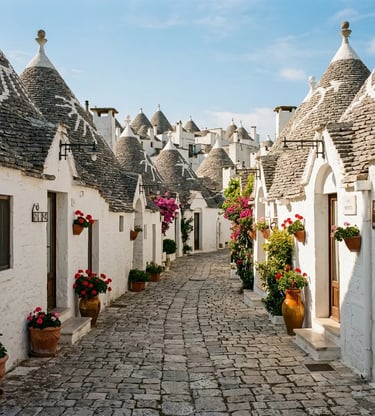
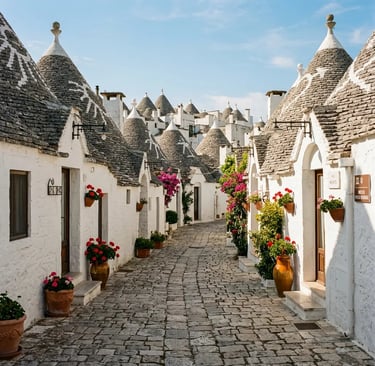
Alberobello is a UNESCO World Heritage site globally recognized for its mortarless Trulli dwellings conical limestone structures that date to the mid-fourteenth century and remain structurally intact without a single drop of binding material. The Trulli of Alberobello are not quaint relics. They are evidence of an engineering logic so sound it has outlasted every modern building on the same hillside. The Rione Monti district contains over 1,000 of these structures along narrow, cascading streets that reward slow, deliberate walking. The 2025 and 2026 travel trend in Puglia heavily favors sustainable, slow tourism away from the logistical nightmare of self-driving, and Alberobello's pedestrian-only historic core is the physical embodiment of that principle.
Locorotondo: The Overlooked Masterpiece
Locorotondo sits on a hilltop less than ten kilometers from Alberobello yet receives a fraction of its foot traffic. The town is arranged in a near-perfect circular plan its name literally translates to "round place" with whitewashed houses featuring distinctive cummerse rooftops unique to this microregion. The panoramic overlook from the Balconata offers an uninterrupted view across the entire Valle d'Itria, and the town's small-production white wines, particularly Verdeca-based blends, are among the most undervalued in Italy. Locorotondo is where informed travelers separate themselves from itinerary followers.
The Visceral Coastal Impact of Polignano a Mare
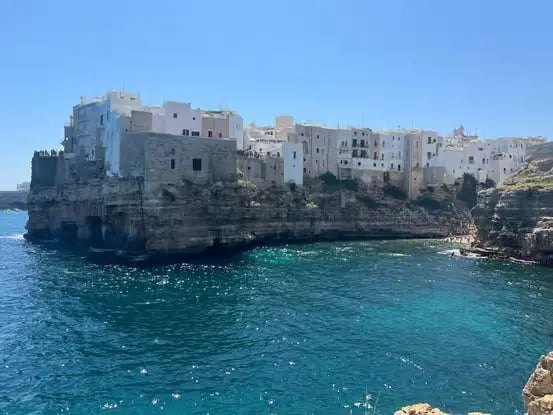
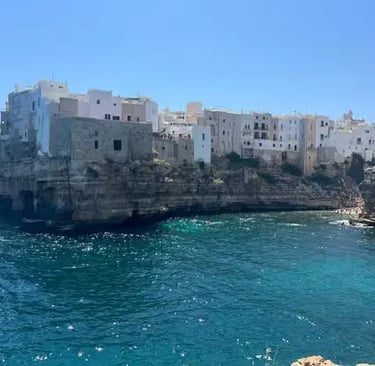
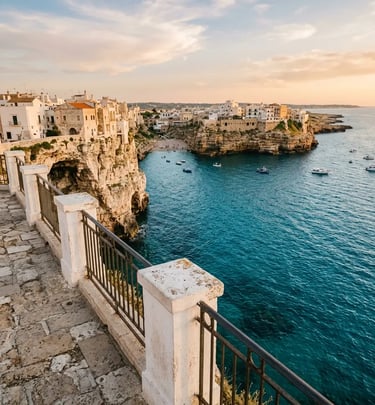
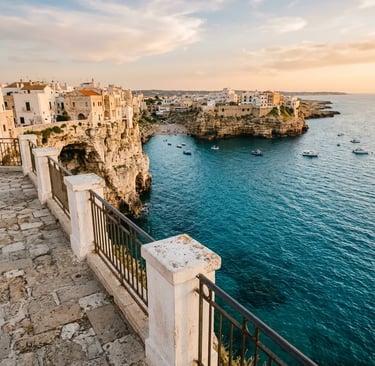
Polignano a Mare is built directly on top of dramatic limestone cliffs above the Adriatic Sea. The famous Lama Monachile a narrow cove flanked by sheer rock walls and crossed by a Roman-era bridge is the single most photographed natural formation on the Adriatic coast of Puglia. But the town delivers far more than one viewpoint. The centro storico is threaded with terraces that open without warning onto seventy-foot vertical drops into turquoise water. The sensory shift from the landlocked, earth-toned calm of Alberobello and Locorotondo to the salt air, open horizon, and vertical geology of Polignano is psychologically deliberate when experienced in this sequence. The route is designed to escalate.
Why Booking This Organized Day Tour Is the Only Logical Decision
The question is not whether these three towns deserve a full day of your time. They do. The question is whether you are willing to sacrifice three to four hours of that day to the administrative burden of rental car logistics, parking strategy, and real-time route problem-solving in a region where English-language signage is sparse and road infrastructure assumes local knowledge.
An organized Apulia day trip with a private transfer from Matera removes every variable that degrades the experience. Door-to-door service. A driver who knows the parking restrictions in Alberobello's ZTL zones. Arrival timing calibrated to avoid midday crowds. Departure sequencing that places Polignano a Mare in the late afternoon, when the cliff-side light is at its most dramatic.
High-value travelers do not optimize for cost. They optimize for the quality of every hour spent. This is the route. This is how it is done correctly.
Frequently Asked Questions About the Matera to Alberobello, Locorotondo & Polignano a Mare Day Trip
How long does the day trip from Matera to Alberobello, Locorotondo, and Polignano a Mare take?
The full guided day trip typically requires between 9 and 11 hours from departure to return, depending on the pace of exploration at each stop. The driving segments between towns are relatively short roughly 60 to 70 minutes from Matera to Alberobello, under 15 minutes from Alberobello to Locorotondo, and approximately 45 minutes from Locorotondo to Polignano a Mare which means the vast majority of the day is spent on foot inside the towns themselves rather than in transit.
This time structure is what makes the route so effective as a single-day itinerary. Each town demands a different type of attention architectural immersion in Alberobello, panoramic contemplation in Locorotondo, and sensory coastal exploration in Polignano a Mare and the compact driving distances between them prevent transit fatigue from eroding the quality of each stop.
An organized private transfer from Matera ensures that timing is calibrated to local realities such as ZTL restricted traffic zones, seasonal parking availability, and crowd density windows. Without this calibration, independent travelers routinely lose 30 to 60 minutes per stop navigating logistics that a knowledgeable local driver resolves before the vehicle even parks.
Is it possible to visit all three towns by public transport in one day?
It is technically possible but practically inadvisable. Direct public transport connections between Matera and the Puglia towns on this route are either nonexistent or dependent on infrequent regional bus schedules with misaligned departure times. The rail network does not serve Matera with a mainline station, and the Ferrovie Appulo Lucane narrow-gauge line that operates in the area follows routes and timetables designed for local commuters, not day-trip visitors attempting a multi-stop itinerary.
The 2025 and 2026 travel trend in Puglia strongly favors sustainable, slow tourism models that prioritize experience density over independent logistics. This is not a philosophical preference — it is a response to the infrastructure reality of the region. Travelers who attempt this route via public transport consistently report that scheduling constraints force them to cut at least one town from the itinerary entirely.
A guided Apulia day trip with a private vehicle and driver is the standard solution recommended by local tourism boards and experienced operators precisely because it converts an unreliable multi-transfer puzzle into a seamless, timed sequence with zero logistical risk.
What makes Alberobello different from other historic towns in Puglia?
Alberobello holds singular status as a UNESCO World Heritage site globally recognized for its mortarless Trulli dwellings — conical dry-stone structures built without any binding material that have remained structurally sound for centuries. While scattered Trulli exist across the Valle d'Itria countryside, only Alberobello contains an entire urban district composed almost exclusively of these buildings. The Rione Monti quarter alone holds over 1,000 Trulli arranged along steep, narrow lanes that create one of the most visually cohesive historic townscapes in Europe.
The Trulli of Alberobello are not decorative. Their construction method reflects a specific economic and political history — local oral tradition holds that the mortarless technique allowed rapid disassembly to evade royal taxation on permanent settlements. Whether fully verified or partially mythologized, this origin narrative adds a layer of strategic intelligence to structures that most visitors initially perceive as purely aesthetic.
Walking through Alberobello demands a slower pace than most Italian town visits. The pedestrian-only historic core, the absence of vehicular noise, and the repetitive geometric precision of the conical rooftops produce a psychological effect closer to meditation than sightseeing. This is a place that rewards attention and punishes haste.
What is the best time of day to arrive in Polignano a Mare during this day trip?
Late afternoon is the optimal arrival window for Polignano a Mare, and well-designed guided itineraries position it as the final stop for precisely this reason. The western-facing limestone cliffs and the famous Lama Monachile cove receive the most dramatic light between 4:00 PM and 7:00 PM during spring and summer months, when low-angle sunlight turns the Adriatic water inside the cove an intense turquoise that is visually impossible under midday overhead sun.
Beyond light quality, afternoon arrival avoids the peak crowd density that builds between 11:00 AM and 2:00 PM when bus tours from Bari discharge large groups into the compact centro storico. The narrow cliff-edge terraces and balconies that define the Polignano experience lose their impact entirely when shared with dense foot traffic. Arriving after the tour bus window closes restores the intimacy that makes the town remarkable.
The emotional sequencing of the full day also benefits from this placement. Moving from the inland, earth-toned quiet of Alberobello and Locorotondo to the sudden vertical drama of Adriatic cliffs and open salt air creates a sensory crescendo that functions as a natural climax to the itinerary. Experienced operators understand this psychological architecture and build their schedules around it deliberately.
Connect
Join us for travel tips and destination insights.
© 2026. All rights reserved.
Affiliate disclaimer
This website contains affiliate links. If you purchase through these links, we may earn a commission at no extra cost to you.