
The Definitive Matera Day Trip: Polignano a Mare, Alberobello, and Locorotondo in One Seamless Journey
Book a Matera day trip to Polignano a Mare, Alberobello, and Locorotondo. Private Apulia transfer covering UNESCO Trulli, Adriatic cliffs, and Valle d'Itria views in one seamless journey.
DAY TRIPS
DestinationDiscover
5/31/20266 min read
Southern Italy punishes improvisation. The narrow roads between Basilicata and Puglia were not designed for rental cars driven by visitors reading GPS directions in a language they do not speak. When you book a Matera day trip with a professional Apulia private transfer, every logistical variable is removed from your hands and placed into the control of someone who has driven these routes thousands of times.
This is how experienced travelers move through southern Italy without friction, without wasted hours, and without a single moment of uncertainty.
Key Takeaways
A guided day trip from Matera covers three of Puglia's most visually significant destinations in a single, optimized route.
The Trulli of Alberobello hold UNESCO World Heritage status and cannot be replicated anywhere else on Earth.
Polignano a Mare cliffs offer one of the most dramatic coastal landscapes on the entire Adriatic seaboard.
A Locorotondo guided tour reveals the Valle d'Itria panorama from the highest vantage point in the Itria Valley.
An Apulia private transfer eliminates every logistical risk associated with self-driving between regions.
Why Matera Is the Ideal Starting Point
Matera sits on the western edge of the Murgia plateau in Basilicata, separated from the heart of Puglia by approximately ninety minutes of winding provincial roads. The city's ancient Sassi districts already place you in one of Europe's most historically layered landscapes. From this position, the route east into Apulia opens access to three destinations that define the architectural and geographic identity of the region.
Attempting this route independently requires navigating ZTL restricted traffic zones, locating unmarketed parking areas, and managing timing across three towns with no centralized transit connections. A structured day trip removes every one of these obstacles before you encounter them.
Alberobello: The UNESCO Trulli District
Architecture Without Precedent
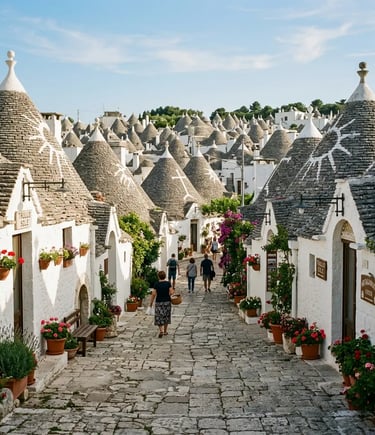
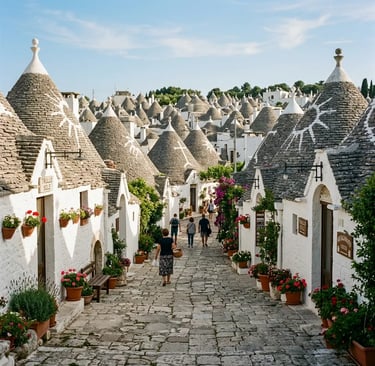
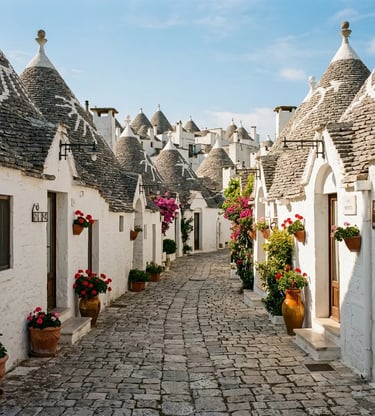
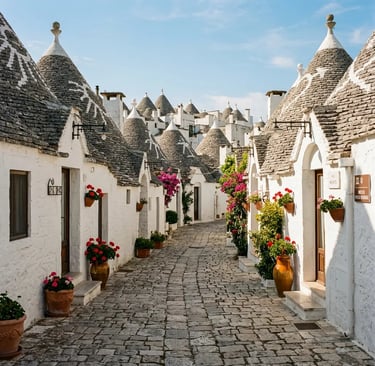
Alberobello contains over 1,500 Trulli dry-stone conical structures built without mortar, clustered along the slopes of the Rione Monti and Aia Piccola quarters. The Trulli of Alberobello represent a construction method dating to the 14th century, originally designed to allow rapid disassembly for tax evasion purposes. UNESCO inscribed the site in 1996, and its density of intact Trulli remains unmatched globally.
Walking through the Rione Monti quarter without a guide means missing the structural and historical context embedded in every lane. A guided visit ensures you absorb the significance rather than simply photographing surfaces.
Locorotondo: The White Crown of Valle d'Itria
Circular Geometry and Panoramic Authority
Locorotondo takes its name from its circular urban layout — locus rotundus — visible from aerial perspectives as a near-perfect ring of white-washed buildings. The town occupies the highest elevation in the Itria Valley, and its terraces deliver unobstructed panoramic views across the Valle d'Itria stretching toward the Adriatic coast.
A Locorotondo guided tour routes you through the historic center's narrow vicoli, past Baroque church facades and balconied palazzi that most independent visitors walk past without recognition. The town also produces Locorotondo DOC, a crisp white wine available in local enoteche along the central passeggiata.
Polignano a Mare: The Adriatic's Most Dramatic Coastline
Cliffs, Caves, and the Abbey of San Vito
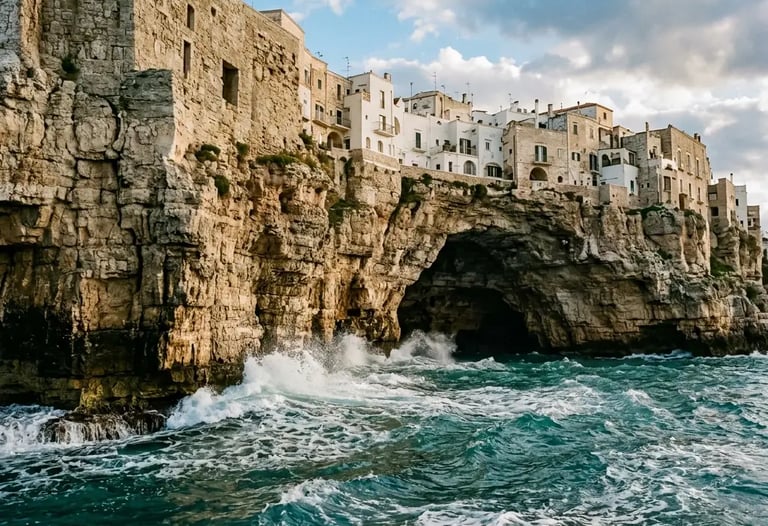
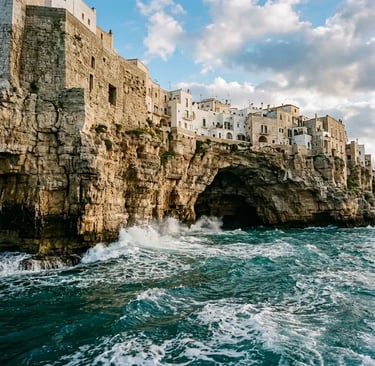
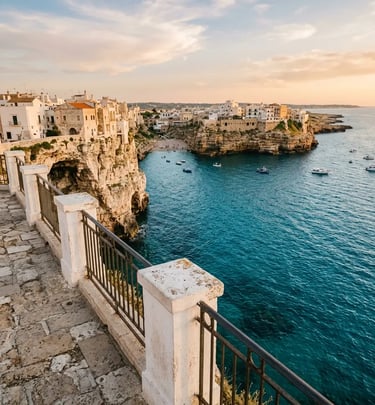
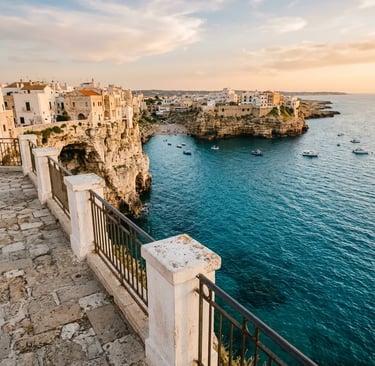
The Polignano a Mare cliffs drop vertically into turquoise Adriatic water from heights exceeding twenty meters. The old town perches directly on these limestone formations, with buildings extending to the cliff edge and natural sea caves carved into the rock below. The Abbazia di San Vito, a Benedictine abbey complex positioned on a promontory north of the town center, adds a layer of medieval religious history to the coastal landscape.
This is the final destination on the route, and its visual impact is calibrated to leave the strongest impression. The cliffs at sunset create a closing experience that independent travelers rarely time correctly.
The Decision That Separates Two Entirely Different Trips
You now hold two versions of this day in front of you. In one, you spend hours managing logistics, arriving late to each town, and leaving early from the ones that matter most. In the other, you step into a vehicle and arrive at each destination at the precise moment the experience is optimized.
Book a Matera day trip with a professional transfer and eliminate every variable standing between you and three of the most visually commanding destinations in southern Italy. The route is designed. The timing is calculated. The only remaining action is yours.
Frequently Asked Questions About the Matera to Alberobello, Locorotondo & Polignano a Mare Day Trip
How long does the day trip from Matera to Alberobello, Locorotondo, and Polignano a Mare take?
The full guided day trip typically requires between 9 and 11 hours from departure to return, depending on the pace of exploration at each stop. The driving segments between towns are relatively short roughly 60 to 70 minutes from Matera to Alberobello, under 15 minutes from Alberobello to Locorotondo, and approximately 45 minutes from Locorotondo to Polignano a Mare which means the vast majority of the day is spent on foot inside the towns themselves rather than in transit.
This time structure is what makes the route so effective as a single-day itinerary. Each town demands a different type of attention architectural immersion in Alberobello, panoramic contemplation in Locorotondo, and sensory coastal exploration in Polignano a Mare and the compact driving distances between them prevent transit fatigue from eroding the quality of each stop.
An organized private transfer from Matera ensures that timing is calibrated to local realities such as ZTL restricted traffic zones, seasonal parking availability, and crowd density windows. Without this calibration, independent travelers routinely lose 30 to 60 minutes per stop navigating logistics that a knowledgeable local driver resolves before the vehicle even parks.
Is it possible to visit all three towns by public transport in one day?
It is technically possible but practically inadvisable. Direct public transport connections between Matera and the Puglia towns on this route are either nonexistent or dependent on infrequent regional bus schedules with misaligned departure times. The rail network does not serve Matera with a mainline station, and the Ferrovie Appulo Lucane narrow-gauge line that operates in the area follows routes and timetables designed for local commuters, not day-trip visitors attempting a multi-stop itinerary.
The 2025 and 2026 travel trend in Puglia strongly favors sustainable, slow tourism models that prioritize experience density over independent logistics. This is not a philosophical preference — it is a response to the infrastructure reality of the region. Travelers who attempt this route via public transport consistently report that scheduling constraints force them to cut at least one town from the itinerary entirely.
A guided Apulia day trip with a private vehicle and driver is the standard solution recommended by local tourism boards and experienced operators precisely because it converts an unreliable multi-transfer puzzle into a seamless, timed sequence with zero logistical risk.
What makes Alberobello different from other historic towns in Puglia?
Alberobello holds singular status as a UNESCO World Heritage site globally recognized for its mortarless Trulli dwellings — conical dry-stone structures built without any binding material that have remained structurally sound for centuries. While scattered Trulli exist across the Valle d'Itria countryside, only Alberobello contains an entire urban district composed almost exclusively of these buildings. The Rione Monti quarter alone holds over 1,000 Trulli arranged along steep, narrow lanes that create one of the most visually cohesive historic townscapes in Europe.
The Trulli of Alberobello are not decorative. Their construction method reflects a specific economic and political history — local oral tradition holds that the mortarless technique allowed rapid disassembly to evade royal taxation on permanent settlements. Whether fully verified or partially mythologized, this origin narrative adds a layer of strategic intelligence to structures that most visitors initially perceive as purely aesthetic.
Walking through Alberobello demands a slower pace than most Italian town visits. The pedestrian-only historic core, the absence of vehicular noise, and the repetitive geometric precision of the conical rooftops produce a psychological effect closer to meditation than sightseeing. This is a place that rewards attention and punishes haste.
What is the best time of day to arrive in Polignano a Mare during this day trip?
Late afternoon is the optimal arrival window for Polignano a Mare, and well-designed guided itineraries position it as the final stop for precisely this reason. The western-facing limestone cliffs and the famous Lama Monachile cove receive the most dramatic light between 4:00 PM and 7:00 PM during spring and summer months, when low-angle sunlight turns the Adriatic water inside the cove an intense turquoise that is visually impossible under midday overhead sun.
Beyond light quality, afternoon arrival avoids the peak crowd density that builds between 11:00 AM and 2:00 PM when bus tours from Bari discharge large groups into the compact centro storico. The narrow cliff-edge terraces and balconies that define the Polignano experience lose their impact entirely when shared with dense foot traffic. Arriving after the tour bus window closes restores the intimacy that makes the town remarkable.
The emotional sequencing of the full day also benefits from this placement. Moving from the inland, earth-toned quiet of Alberobello and Locorotondo to the sudden vertical drama of Adriatic cliffs and open salt air creates a sensory crescendo that functions as a natural climax to the itinerary. Experienced operators understand this psychological architecture and build their schedules around it deliberately.
Connect
Join us for travel tips and destination insights.
© 2026. All rights reserved.
Affiliate disclaimer
This website contains affiliate links. If you purchase through these links, we may earn a commission at no extra cost to you.