
The Definitive Guide to Executing a Private Tour of Valle d'Itria from Lecce
Execute the definitive private tour from Lecce to Valle d'Itria & Alberobello. Luxury driver, trulli architecture, masseria lunch. Plan your day.
DAY TRIPS
DestinationDiscover
4/17/20266 min read
What You Need to Know (Read This First)
Distance & Duration: Lecce to Alberobello is approximately 105 km 1h 30m by private vehicle, versus 3+ hours via train with multiple transfers.
Optimal Season: April through late October. Avoid August the trulli zone becomes saturated with cruise-ship crowds by 11:00 AM.
Core Circuit: Alberobello → Locorotondo → Cisternino → Martina Franca. Expect 9–10 hours door-to-door for a complete experience.
Transport Reality: Public transit into Valle d'Itria is fragmented, slow, and strips the day of spontaneity. A private driver is not a luxury it is the mechanism that makes the region legible.
What Elevates the Day: Pre-arranged access to a privately-owned trullo, a reserved table at a masseria lunch, and an English-speaking driver who understands pacing.
Budget Framework: A quality private tour of Valle d'Itria runs €450–€850 depending on vehicle class and inclusions.
Why the Private Tour Is the Only Rational Choice
Let me tell you what I observe in travelers who choose group coaches: a specific micro-expression around the eyes by hour three. It's resignation. They've surrendered their day to a schedule built for the lowest common denominator the slowest walker, the longest bathroom break, the photo stop nobody asked for.
Luxury travel in Southern Italy isn't about thread count or marble. It's about sovereignty over your own time. A private driver in Valle d'Itria collapses friction at every decision point: no parking hunts in Alberobello's chaotic lower town, no missed connections at Bari Centrale, no waiting for strangers to finish their gelato. You arrive in Locorotondo at 7:45 AM before the tour buses and you walk the whitewashed cummerse alone, in silence, with the light still low. That experience cannot be purchased through a group operator. It can only be engineered.
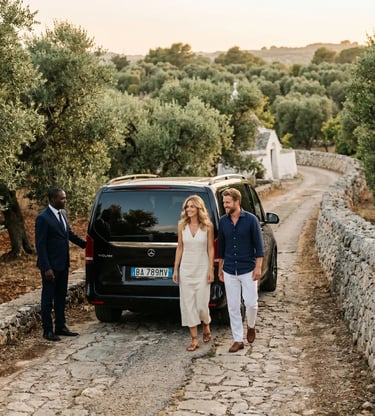
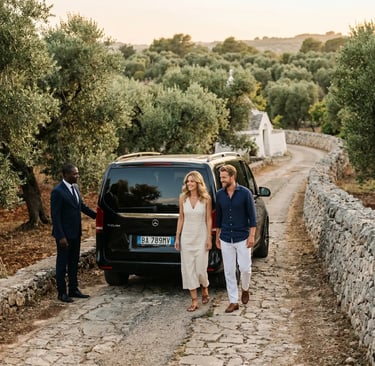
The people who fly into Brindisi or Bari and book a Mercedes V-Class for the day understand something the others don't: the cost of a private tour isn't an expense. It's the price of removing every variable that degrades the memory.
The Architecture of the Trulli: What Your Guide Should Explain
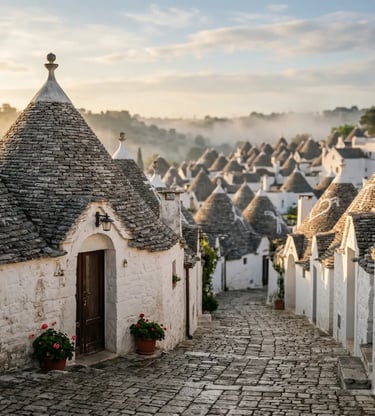
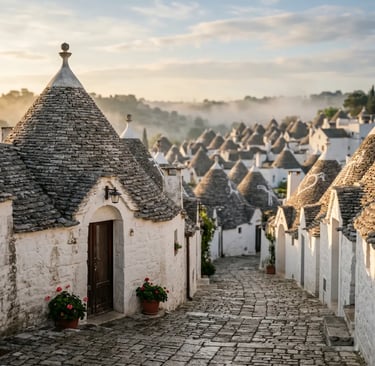
A proper Trulli Alberobello guide doesn't recite Wikipedia. They decode the structure. Here is the framework to expect:
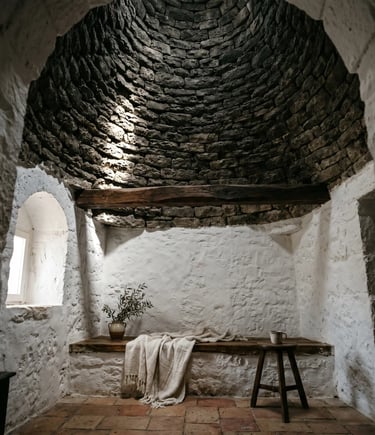
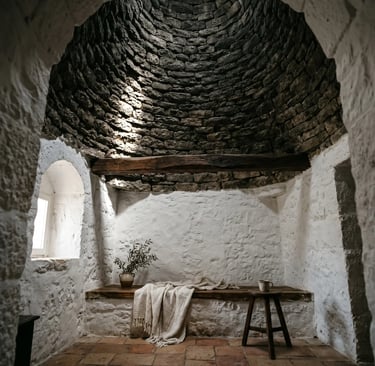
The Dry-Stone Method: Trulli are built entirely without mortar limestone slabs stacked in self-supporting conical domes. This wasn't aesthetic; it was tax evasion. Under 15th-century Kingdom of Naples decrees, mortared dwellings were taxed. A trullo could be dismantled in hours when inspectors approached.
The Pinnacle (Pinnacolo): Each conical roof terminates in a carved limestone symbol — spheres, discs, crosses, pagan sun-wheels. These are signatures of the stonemason who built it. No two are identical.
The Rooftop Glyphs: Painted in white lime on the grey slate cones, you'll see zodiac symbols, Christian crosses, primitive talismans. These are apotropaic meant to repel evil. Roughly 1,620 trulli remain in the Rione Monti district.
The Interior Logic: A single conical chamber per family function. Thick walls maintain 18°C interiors through the Puglian summer without any mechanical cooling. Pre-modern, and still outperforming most modern construction.
UNESCO Status: Designated World Heritage in 1996. The designation is what preserved the town from the concrete expansion that consumed neighboring villages in the 1970s.
Stand in Aia Piccola the quieter, residential district not Rione Monti. That's where the architecture speaks without the souvenir-shop noise.
Executing the Day: The Non-Negotiables
Your driver should depart Lecce no later than 7:00 AM. You'll reach Alberobello before the morning coaches disgorge at 9:30. Spend ninety focused minutes, then move to Locorotondo recognized as one of the Borghi più belli d'Italia for espresso in the circular old town.
Lunch is the leverage point of the entire day. Book a working masseria Masseria Il Frantoio or Masseria Torre Coccaro where the meal runs two hours, eight courses, and ends with a walk through the olive groves. This is the moment travelers remember a year later. Not the photos. The meal.
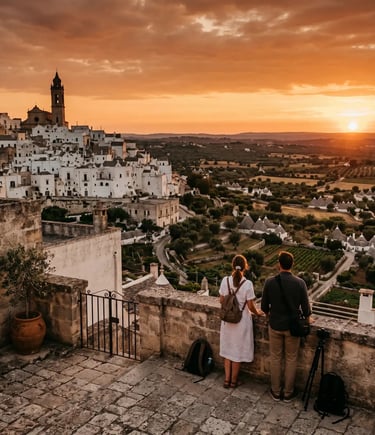
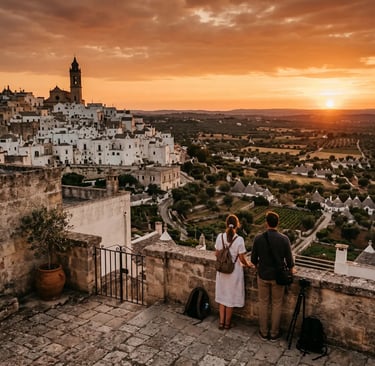
Close the loop through Cisternino at golden hour, returning to Lecce by 7:30 PM.
A private tour of Valle d'Itria isn't a day trip. It's a demonstration to yourself of what travel looks like when nothing is left to chance.
Frequently Asked Questions: Private Tour from Lecce to Valle d'Itria
How long is the drive from Lecce to Alberobello, and is it worth doing as a day trip?
The drive from Lecce to Alberobello covers approximately 105 kilometers and takes 1 hour and 30 minutes by private vehicle via the SS16 coastal route. With a private driver departing Lecce at 7:00 AM, you arrive in Alberobello before the tour buses, giving you nearly two hours of uninterrupted access to the Rione Monti and Aia Piccola districts.
Yes it is absolutely worth the day trip, but only when executed privately. The return journey by train requires two or three transfers through Bari Centrale and consumes nearly seven hours of travel time round-trip, leaving you with barely four usable hours in the region. That compression makes the public transport option functionally worthless for anyone wanting to visit more than one village.
A properly structured private tour extracts 9 to 10 productive hours from the day, covering Alberobello, Locorotondo, Cisternino, and a masseria lunch. The efficiency differential between private and public transport in Valle d'Itria is the single largest quality-of-experience variable in all of Puglia.
What is the best time of year to visit Alberobello and the Valle d'Itria region?
The optimal window runs from mid-April through late June, and again from mid-September through the end of October. During these periods, temperatures sit between 20 and 27 degrees Celsius, the olive groves are either in bloom or approaching harvest, and the light quality across the whitewashed villages is photographically exceptional.
Avoid August at all costs. The combination of 38-degree heat, saturated cruise-ship excursions from Bari, and closed family-run restaurants (many owners take their own holiday) degrades the experience measurably. July is tolerable only if you commit to a 6:30 AM departure from Lecce.
Winter travel from November through March offers empty streets and dramatic light, but many masserie, trulli accommodations, and rural restaurants operate reduced hours or close entirely. If you travel in this period, your private driver becomes even more critical they know which establishments remain open and can secure access where public information fails.
Can I enter and see the inside of a trullo in Alberobello?
Yes, and the quality of that access depends entirely on how your tour is structured. Several trulli in the Rione Monti district operate as open-door souvenir shops where you can step inside briefly, but these provide only a superficial impression of the architecture and none of the historical context.
The authentic experience requires a privately arranged visit typically a family-owned trullo where the current resident opens their home, explains the dry-stone construction, the rooftop pinnacle symbols, and the thermal logic of the conical chambers. A competent private tour operator has three or four such relationships and can secure one with 48 hours notice.
For overnight immersion, book a trullo stay in Alberobello or the surrounding countryside. Sleeping inside an 18th-century dry-stone structure where the walls maintain a constant 18 degrees without mechanical cooling transforms the visit from tourism into architectural pilgrimage.
Should I choose a group tour or a private driver for Valle d'Itria?
The honest answer: a group tour from Lecce to Valle d'Itria will technically deliver you to Alberobello, but it will strip the day of everything that makes the region remarkable. Group itineraries are built around the lowest common denominator fixed stops, rushed photo windows, mandatory shopping visits, and departure times calibrated to the slowest participant.
A private driver eliminates every point of friction. You control the departure time, the sequence of villages, the duration at each stop, and critically the lunch venue. Private tours also unlock the smaller villages that group coaches cannot physically enter: the narrow streets of Cisternino and the upper town of Locorotondo are inaccessible to any vehicle larger than an executive sedan or V-Class van.
The cost differential is meaningful but not extreme. Group tours run 80 to 120 euros per person; a private tour for two to six passengers runs 450 to 850 euros total. When divided across a couple or small group, the per-person cost is often comparable, and the experiential gap is not comparable at all. For any traveler prioritizing the quality of the day over the line item on the invoice, the private tour is the only rational choice.
Connect
Join us for travel tips and destination insights.
© 2026. All rights reserved.
Affiliate disclaimer
This website contains affiliate links. If you purchase through these links, we may earn a commission at no extra cost to you.