
The Alpine Secret Most Tourists Walk Right Past (And Why Your Family Will Never Forget It)
Discover the Ehrwald two lakes hike Seebensee and Drachensee. A moderate, family-friendly trail through Tyrol's nature reserve with stunning photography spots. Book now, pay later with free cancellation.
DAY TRIPS
DestinationDiscover
2/19/20269 min read
Affiliate Disclosure
This article contains affiliate links. If you purchase through these links, I may earn a small commission at no extra cost to you. I only recommend products I genuinely believe offer strong performance, quality, and value for your ski and travel experience.
You round a bend in the trail, and your brain stops processing language for a moment.
It just… receives.
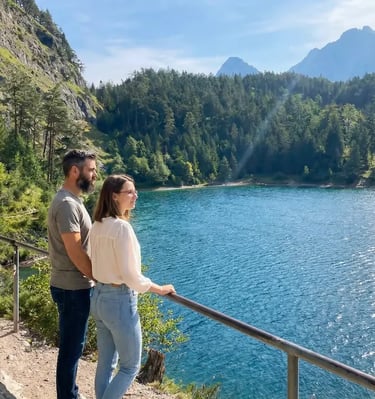
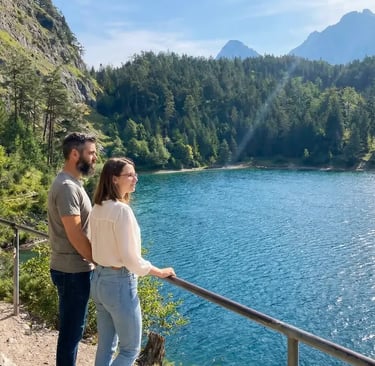
A lake so still it doesn't reflect the mountains it absorbs them. The water isn't blue. It isn't green. It's the color that exists between those two words, a shade your phone camera will try and fail to capture. The air hits your lungs like a cold drink you didn't know you were thirsty for.
This is Seebensee. And almost nobody from the States knows it exists.
Let me fix that.
What Happens When You Stop Hiking and Start Arriving
Most travel blogs will tell you about the "beautiful views" on this trail. I'm not going to do that. Instead, I want to talk about what happens inside your chest when you stand at the shore of a glacial lake at 1,657 meters and realize your seven-year-old just hiked there under her own power.
That feeling — that specific cocktail of pride, awe, and quiet is the real destination.
The Ehrwald two lakes hike is not famous in America. Not yet. European hikers have been quietly protecting this route the way you'd protect your favorite local restaurant before a food critic finds it. The Seebensee and Drachensee hike sits inside a nature reserve in Tyrol, and the trail treats you like a guest, not a tourist. It's wide where it needs to be wide. It's shaded where the sun would slow you down. And it reveals itself in stages like a story that knows exactly when to turn the page.
Here's what most guides won't tell you: the hike itself is a psychological experience as much as a physical one. The first thirty minutes feel ordinary. Pleasant, yes. Pine-scented air, soft earth underfoot, the sound of a creek doing what creeks have done for ten thousand years. But ordinary.
Then the trees open.
And you understand why you came.
Two Lakes. Two Completely Different Conversations With Yourself.
Seebensee is the exhale.
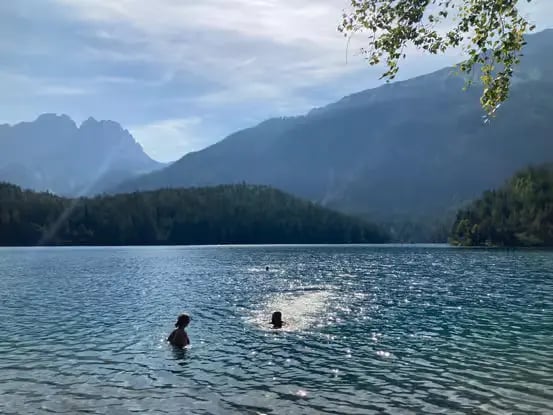
You arrive and the trail flattens into a wide, grassy shoreline. Children throw stones. Couples sit on boulders and say nothing important, which is the most important kind of conversation. The Wetterstein range fills the background like a painting that hasn't been hung yet it's just there, leaning against the sky. This is an easy hiking trail in Ehrwald that somehow delivers what people pay thousands to experience in more "famous" destinations.
The water temperature will remind you that glaciers don't care about your comfort. Dip your hand in anyway. Your body remembers cold like this. It's the kind of cold that makes you laugh for no reason.
Now. Here's where things get interesting.
Drachensee Dragon Lake sits 200 meters higher. The trail narrows and steepens. Your calves will have a brief negotiation with your ambition. It takes roughly 30 to 40 additional minutes, and the path is rocky enough to make you feel like you're earning something without ever feeling unsafe.
When you crest the ridge, the lake appears like it was waiting specifically for you.
Drachensee is smaller, darker, colder, and dramatically more intimate. The cliffs press closer. The silence has texture. If Seebensee is a conversation, Drachensee is a confession the kind of place where you suddenly remember what you actually want from your life.
This is a moderate hike through Austria's nature reserve system, and that word "moderate" is doing important work. It means your teenagers won't be bored. It means your parents can join. It means you won't spend the next day unable to walk down stairs.
Why Families Keep Coming Back (The Psychology of the Perfect Hike)
I've studied what makes experiences stick in memory, and this trail hits every marker.
Manageable challenge with visible reward. Children need to feel capable, not carried. The Seebensee portion is gentle enough for kids as young as five or six with reasonable hiking experience. The Drachensee extension gives older kids and teens a genuine sense of accomplishment. This is why locals consistently rank it as the best family hike in Austria it gives every member of the family their own version of victory.
Sensory richness. Your brain encodes memories more deeply when multiple senses are activated simultaneously. The smell of Austrian pine is not the same as any pine you've encountered in the Rockies or the Appalachians it's sharper, more resinous, almost medicinal. The sound of cowbells from a nearby alm. The feel of ancient granite under your boots. Your family won't just remember this hike. They'll re-experience it every time someone mentions Austria.
Shared awe. Research consistently shows that experiencing awe in a group especially a family strengthens social bonds in ways that regular "quality time" simply cannot replicate. Standing together at the edge of Drachensee, watching the clouds move across the surface like slow-motion thoughts, does something to a family that a resort pool never will.
This is not just a family friendly hiking trip in Tyrol. It's a deposit in your family's emotional bank account.
Where to Point Your Camera (And Where to Put It Away)
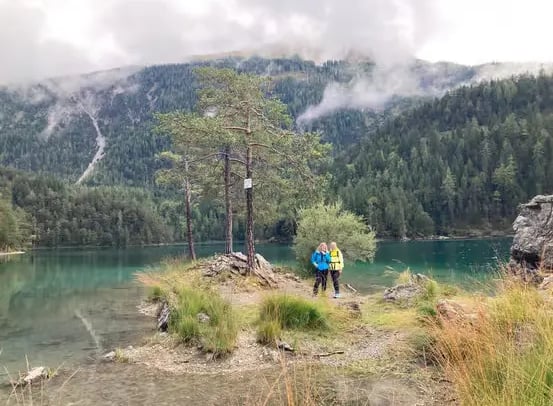
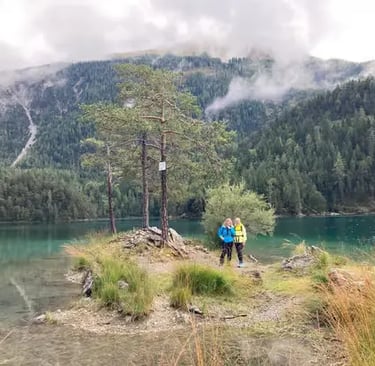
Let's talk about the best photography spots on a hike near Ehrwald, because some of them are obvious and some of them will make your Instagram followers ask "where IS that?"
Spot One: The Seebensee Approach. About fifty meters before you reach the lake, the trail bends left and the full panorama opens. Stop here. Shoot wide. The lake, the meadow, the mountains this is the postcard shot. Morning light turns the water into liquid jade. Late afternoon adds gold to the peaks.
Spot Two: The Reflection Point. Walk to the eastern shore of Seebensee, away from where most hikers gather. On a calm morning, the reflection of the Zugspitze massif is so perfect it becomes genuinely disorienting you can turn the photo upside down and it still looks right.
Spot Three: The Drachensee Cliff Edge. Fifteen meters past the point where you first see Drachensee, there's a rocky outcrop on the left. Sit on it. Shoot down toward the water. The depth of color in that lake almost black at the center, electric teal at the edges creates the kind of contrast that makes people stop scrolling.
Spot Four: The one you won't photograph. Somewhere on this trail, you'll hit a moment where the light and the air and the view converge into something that makes you lower your phone. That moment is the real souvenir. Let it happen.
Practical Tips for Hiking Seebensee and Drachensee (From Someone Who's Made the Mistakes)
Start early. Not because the trail is crowded it's remarkably uncrowded compared to anything near Zermatt or Chamonix but because morning light on these lakes is an entirely different experience than afternoon light. You want both, ideally, but if you're choosing, choose morning.
Footwear matters more than fitness. This isn't a trail that demands peak physical condition. It demands ankle support. The Drachensee ascent has loose stone sections that punish running shoes. Mid-cut hiking boots are your friend.
Pack layers. Ehrwald sits at roughly 1,000 meters. The lakes sit between 1,650 and 1,870 meters. That elevation difference translates to a temperature drop that can surprise you, especially if clouds roll in. The Tyrolean Alps don't negotiate with your wardrobe choices.
Bring real food. Not granola bars. A piece of bread, some cheese, an apple eaten on a boulder next to a glacial lake, this becomes the best meal of your trip. Trust me.
The trail is well-marked and the two lakes nature reserve is carefully maintained. You don't need a guide. You don't need GPS. You need your eyes open and roughly four to five hours of unhurried time.
The Part Where I'm Supposed to Sell You Something (But I'd Rather Be Honest)
Here's the thing about moments like Seebensee and Drachensee: they have an expiration date. Not because the lakes are going anywhere they've been here since the last ice age, and they'll outlast us all. The expiration date is on your window.
Your kids are the age they are right now, today, for a very limited time. The window where they're old enough to hike but young enough to be genuinely awestruck by a mountain lake is not a window that stays open forever. Next summer they'll be a year older. The summer after that, two years. The moment when your daughter rounds that bend and her eyes go wide and she grabs your hand without thinking about it that moment is perishable.
This particular guided hiking experience comes with free cancellation, which means the only risk is the risk of not going. And the book now, pay later option removes the last practical barrier between you and that moment at the water's edge.
You don't need to decide if this is the right trip.
You just need to decide if this is the right year.
I think you already know the answer.
The Ehrwald two lakes hike operates during the summer hiking season, typically June through October, weather depending. Trail conditions vary. The route described covers the Seebensee and Drachensee circuit and is suitable for families with children who have basic hiking experience. All ages. All fitness levels with reasonable preparation. No regrets.
Frequently Asked Questions About the Wachau Valley Tour from Vienna
How long does the Wachau Valley tour from Vienna take?
The full day trip typically lasts between 8 and 10 hours, depending on the season and whether the Danube River boat cruise is included. You depart Vienna in the morning and return in the late afternoon or early evening, giving you plenty of time to explore Melk Abbey, wander through Dürnstein, and enjoy a wine tasting without feeling rushed.
This is a comfortably paced experience designed for travelers who want depth over speed. Every stop has enough allocated time for you to absorb the atmosphere rather than just snap a photo and move on.
Is the Danube River cruise included in every tour?
The Danube River boat cruise Wachau Valley segment is seasonal and typically operates from April through October. During the sailing season, the cruise between towns is one of the most memorable parts of the entire trip floating past vineyard-covered hills and castle ruins is an experience unlike anything else in Austria.
Outside of the cruise season, the itinerary is adjusted so you still visit all major stops by land. The experience remains exceptional either way, though if the boat ride is important to you, planning your visit during warmer months is recommended.
Can I cancel or change my booking if my plans change?
Absolutely. This tour comes with free cancellation, which means you can secure your spot today and adjust later if something shifts in your itinerary. Combined with the book now pay later option, you're essentially reserving your place with zero financial risk upfront.
This flexibility is especially valuable for travelers still finalizing their Vienna schedule. Lock in your date, and if a better day opens up or plans evolve, you're fully covered.
Do I need to arrange my own transport to the meeting point?
No. Pickup is included with this tour, which eliminates the stress of navigating public transport or finding a meeting point on your own. You're collected from a convenient central location in Vienna and returned at the end of the day.
This is one of those details that sounds minor but genuinely transforms the experience. Your day starts relaxed instead of rushed, and you finish without worrying about how to get back to your hotel.
Is this tour suitable for families with children?
Yes, families are welcome and children generally enjoy the experience more than parents expect. The Melk Abbey guided tour brings history to life with stories of monks and kings that captivate younger visitors, and the Danube cruise offers a sense of adventure that appeals to all ages.
Dürnstein's castle ruins with their tale of Richard the Lionheart's imprisonment are particularly exciting for kids who love a good historical mystery. The pace of the small group tour also allows families to move comfortably without pressure.
What is the difference between a small group tour and a private day trip?
A Wachau Valley small group tour typically includes a limited number of travelers, which means more personal attention from your guide, flexibility at each stop, and a far more intimate atmosphere than large coach tours. It strikes the ideal balance between social experience and personal space.
A Wachau Valley private day trip takes this further it's just you and your party with a dedicated guide. You set the pace, linger where you want, and skip what doesn't interest you. For couples, families, or anyone who values complete control over their day, the private option is the premium choice.
Can I combine this with a trip to Hallstatt?
Many travelers pair this experience with a Wachau Valley and Hallstatt tour on separate days to cover two of Austria's most spectacular destinations. The Wachau Valley delivers cultural richness, world-class wine, and Baroque grandeur, while Hallstatt offers dramatic alpine scenery and lakeside charm.
Doing both on consecutive days gives you a remarkably complete picture of Austria beyond Vienna. If your schedule allows two day trips, this combination is arguably the best use of your time in the country.
Connect
Join us for travel tips and destination insights.
© 2026. All rights reserved.
Affiliate disclaimer
This website contains affiliate links. If you purchase through these links, we may earn a commission at no extra cost to you.