
Capri Sea Caves Guide: The Geological Truth Behind the Blue and Green Grottoes
Capri sea caves guide: the physics of the Blue Grotto, the Faraglioni geology, and why a Positano boat trip with skipper is the only way to see it all.
DAY TRIPS
DestinationDiscover
5/24/20265 min read
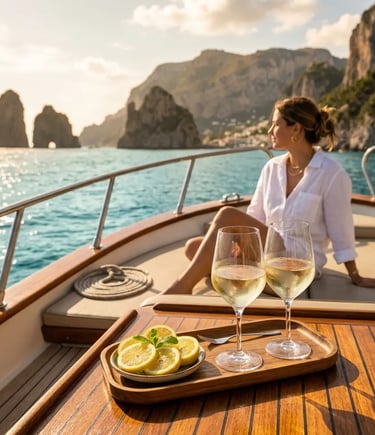
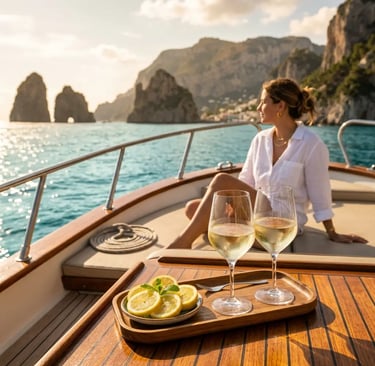
The coast between Positano and Capri is not a postcard. It is a 250-million-year-old limestone archive Mesozoic carbonate platforms uplifted by tectonic compression and sculpted by karst dissolution, marine erosion, and Pleistocene sea-level shifts. What you see from the deck of a boat is the cross-section of an ancient seabed. What you see from a beach lounger is almost nothing.
This guide explains what the Capri sea caves actually are, why they look the way they do, and the only logistical configuration that lets you witness them in a single day without the planning collapsing into chaos.
The Blue Grotto: A Lesson in Light Physics
The Grotta Azzurra does not glow because the water is dyed. It glows because of refraction.
The cave has a small surface entrance roughly one meter high but beneath it sits a much larger submerged opening. Sunlight enters through that underwater arch. As it passes through seawater, the longer wavelengths (red, orange, yellow) are absorbed within the first meters. Only the shorter blue wavelengths survive the journey. They reflect off the cave's pale sandy floor and illuminate the chamber from below, producing the saturated electric blue that has no equivalent anywhere else in the Mediterranean.
This is the Blue Grotto natural phenomenon at its core: a chromatic filter, not a paint job. It functions only when the sea is calm, the sun is high, and a small rowboat the only craft that fits the entrance can ferry you inside.
The Green Grotto: The Same Coast, A Different Spectrum
A few hundred meters along the cliff, the Grotta Verde performs the opposite trick. Its entrance is wide. Direct sunlight enters above the waterline, reflects off limestone walls coated in yellow-green algae, and tints the water emerald. You can swim here. You cannot swim in the Blue.
Together, the Green and Blue Grottoes natural phenomena form a paired demonstration of how light, geometry, and mineral composition interact at the meter scale.
The Faraglioni: Three Stacks, One Erosion Story
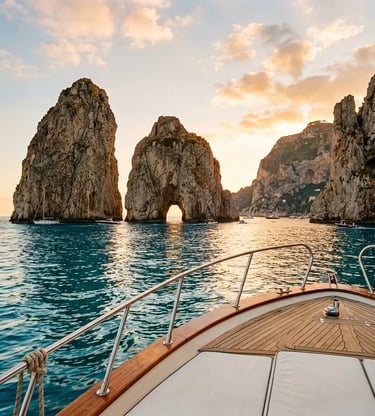
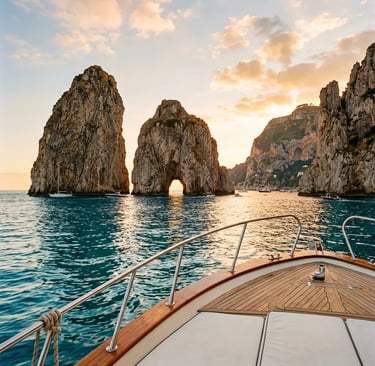
The three towers off Capri's southern flank Stella, Mezzo, and Scopolo are sea stacks. They were once part of the island. Wave action, freeze-thaw cycles, and chemical weathering attacked the weakest joints in the limestone over hundreds of thousands of years until arches collapsed and isolated columns remained. The arch through Faraglione di Mezzo is one of the few natural sea arches in the Mediterranean wide enough for a boat to pass through. You will pass through it.
Why a Positano Boat Trip with Skipper Is the Only Workable Configuration
A Positano boat trip with skipper is not a luxury upgrade. It is the operational baseline.
Public ferries unload thousands of day-trippers onto Marina Grande Capri before noon. They run on rigid schedules, drop you on a crowded pier, and force you to queue twice once for a Blue Grotto rowboat transfer, once for lunch. A private skippered vessel inverts the equation. Your skipper reads the sea state at sunrise, sequences stops to beat the rush at the grottoes, anchors at swimming coves the ferries cannot reach, and delivers you to Marina Grande Capri only if you want to step ashore.
This is the Capri sea caves guide that locals follow. There is no shortcut around it.
What an Eight Hour Day Looks Like
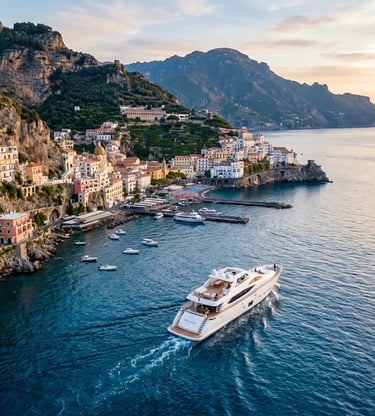
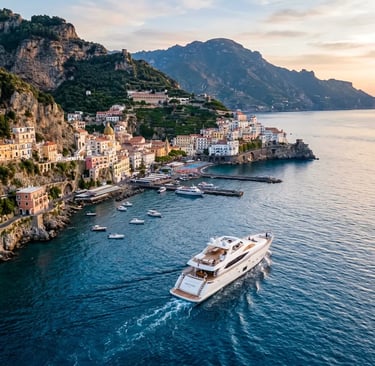
Hotel pickup in Positano. Coastline cruise past Praiano, Furore, and the Li Galli islets. Approach to Capri from the north. Blue Grotto entry by rowboat. Swim stop at the Green Grotto. Pass-through at the Faraglioni arch. Anchor at Marina Piccola or Marina Grande Capri for lunch ashore. Return cruise with stops at hidden coves for swimming and an onboard freshwater shower before you step back onto your hotel's dock.
Life jackets are provided. The shower is real. The skipper is licensed for the Gulf of Naples.
Permission to Stop Planning
You have read the geology. You have read the logistics. The Amalfi Coast is not a place you negotiate with a ferry timetable and a guidebook. It is a place you enter through one specific door a small boat, a skipper who knows the water, and an eight-hour window aligned with the sun.
Book the Positano–Capri skippered tour. Close the tabs. The coast has been here for 250 million years; the calendar has not.


Frequently Asked Questions About the Positano–Capri Boat Tour
Why does the Blue Grotto glow blue?
The Blue Grotto glows because of light refraction, not pigment. Sunlight enters through a large submerged opening beneath the cave's small surface entrance, and seawater absorbs the longer red and yellow wavelengths within the first few meters. Only the short blue wavelengths survive, reflecting off the pale sandy floor and illuminating the chamber from below. The effect is strongest between 10 AM and 2 PM on calm, sunny days, which is why timing your arrival with a private skipper matters far more than most visitors realize.
Can I swim inside the Blue and Green Grottoes?
You cannot swim inside the Blue Grotto. Entry is regulated and restricted to small licensed rowboats that ferry passengers through the meter-high opening, with no swimming permitted inside the chamber. The Green Grotto operates under different rules entirely. Its wide entrance allows direct boat access and swimming in the emerald-tinted water, which gets its color from sunlight reflecting off algae-coated limestone walls. A skippered tour positions you at both caves with the correct equipment and timing for each.
How do I get from Positano to Capri without using the public ferry?
The most reliable option is a private Positano boat trip with skipper, which typically includes hotel pickup, an eight-hour itinerary, life jackets, an onboard freshwater shower, and full route flexibility. Unlike public ferries that follow fixed schedules and deposit crowds at Marina Grande Capri before noon, a skippered vessel adjusts its sequence to sea conditions and grotto access windows. You stop at hidden coves, pass through the Faraglioni arch, and step ashore on Capri only if you choose to.
What makes the Faraglioni rocks geologically significant?
The three Faraglioni Stella, Mezzo, and Scopolo are sea stacks formed over hundreds of thousands of years as wave action, freeze-thaw cycles, and chemical weathering attacked weak joints in Capri's Mesozoic limestone. Sections of the original coastline collapsed, leaving isolated towers behind. Faraglione di Mezzo contains one of the few natural sea arches in the Mediterranean wide enough for a boat to sail through, which is a standard stop on the eight-hour Positano–Capri itinerary.
Connect
Join us for travel tips and destination insights.
© 2026. All rights reserved.
Affiliate disclaimer
This website contains affiliate links. If you purchase through these links, we may earn a commission at no extra cost to you.