
The Bernina Express: How a Single Train Ride Rewires Your Perception of the World
Discover how the Bernina Express train journey from Milan to St. Moritz — through the UNESCO-listed Rhaetian Railway, Valtellina valley, and Engadin Alps — transforms your perception of landscape, silence, and self. A complete sensory and psychological travel guide.
DAY TRIPS
DestinationDiscover
3/29/20266 min read


There is a moment, somewhere between the last rooftop of Tirano and the first granite wall of the Swiss Alps, when your nervous system simply stops arguing with beauty.
It surrenders.
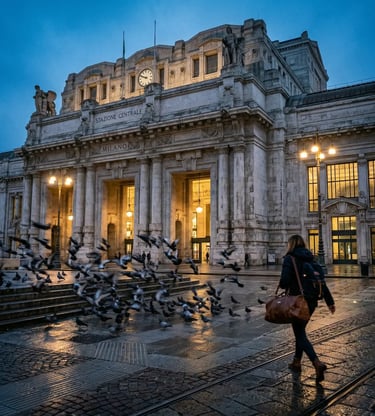
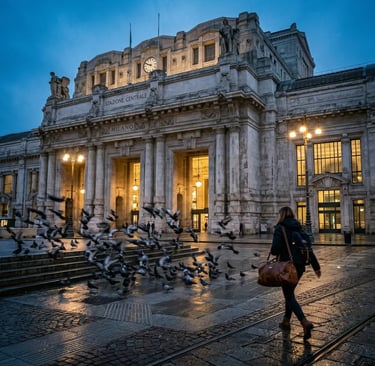
You left Milan this morning a city that hums at a frequency you've absorbed into your bones without noticing. The espresso, the horns, the light fracturing off palazzo windows, the particular weight of a city that has been performing civilization for two thousand years. That energy is real. It lives in your shoulders, behind your eyes, in the shallow rhythm of your breath.
And then the Bernina Express begins its ascent, and everything you thought you understood about landscape quietly dissolves.
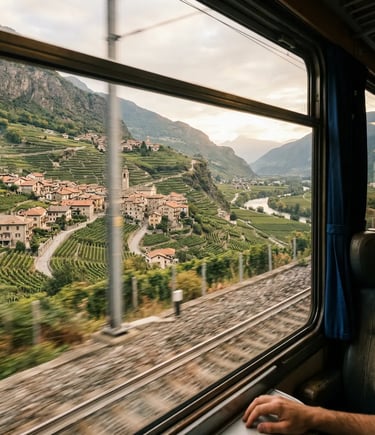
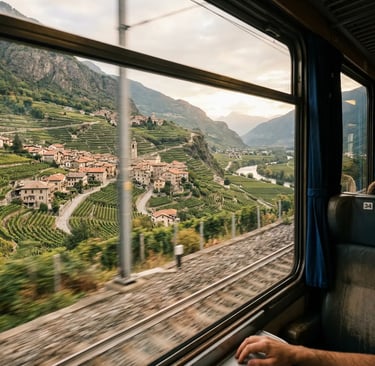
Consider what happens when the Valtellina valley first opens around you. The train moves south of Tirano through terraced vineyards ancient, patient, carved into hillsides by hands that trusted the process across generations. The vines are close enough to touch through the panoramic carriages' floor-to-ceiling glass, and for a strange, suspended moment, you feel less like a passenger and more like a witness to something confessional. The land is telling you something. You're not yet sure what.
And as you realize the gradient is steepening as the train climbs without a rack-and-pinion system in a feat of engineering that still defies casual understandingyour inner monologue, that relentless metropolitan commentary, begins to lose signal.
This is not metaphor. This is neurology.
The Bernina Pass arrives at 2,253 metres, and the world above the treeline is a different planet. Snow-polished granite. Ice-blue lakes Lago Bianco on one side, Lago Nero on the other divided by a watershed that sends water toward two different seas. The panoramic carriages frame each window like a curated exhibition, rotating through compositions that no human photographer could have planned: a lone stone chapel against a white ridge, a curl of cloud dragging itself through a valley far below, the particular silver of Alpine light at altitude that has no equivalent colour in any urban palette.
The Engadin Alps do not perform grandeur. They simply are it, and the difference is staggering when you encounter it without defence.
What you're experiencing is sensory overload of the most generous kind not the anxious overwhelm of a crowded city but an overwhelm of silence, scale, and geological time. Your senses, accustomed to filtering noise, suddenly have nothing to filter. They open, fully, like an aperture in perfect light.
This is a UNESCO World Heritage site the Rhaetian Railway across the Bernina and that designation carries legitimate weight here. The Landwasser Viaduct, curving impossibly above a gorge on six stone arches, is not merely photogenic. Standing in a panoramic carriage as you cross it, you understand that certain human achievements are acts of devotion as much as engineering. Someone looked at an impossible problem and decided that beauty was a valid solution.
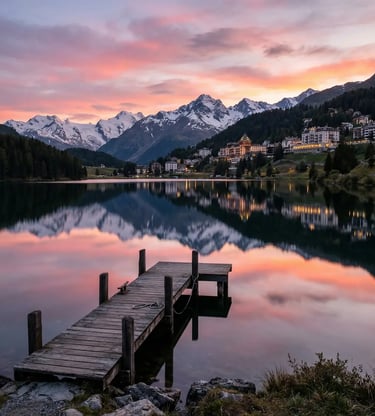
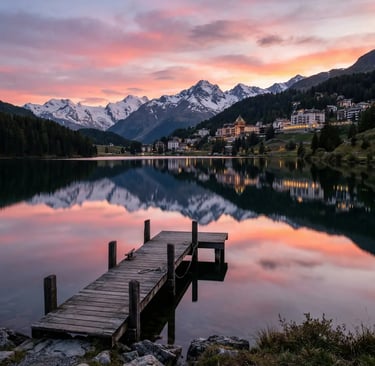
By the time St. Moritz appears its lake first, then its impossible light, then the town itself draped across the hillside with the quiet confidence of a place that has never needed to explain itself you are not the same person who boarded in Milan.
Something has been reset.
And this is precisely why the private transfer back to Milan is not a footnote to the experience. It is the experience's final, essential movement.
The train demands your full presence. The return journey by private transfer gives you something equally rare: interior space. Moving through the Engadin and back down through the Valtellina valley at ground level, cocooned in quiet, you begin the slow process of metabolising what you've witnessed. The Alps recede in the rear window. The vineyards return. The air thickens gradually, imperceptibly, back toward the Po plain.
You are neither fully in the mountains nor fully back in the city. You are in the transitional state that all genuine travel creates that liminal hour when you are briefly, beautifully between who you were and whoever this has made you.
Some journeys move you across geography. The scenic Alpine train journey from Milan through the Engadin Alps to St. Moritz moves you across something harder to name and more worth finding.
Bring your eyes. Leave your certainties at the platform.
The mountain will handle the rest.
Frequently Asked Questions About the Bernina Express Journey from Milan to St. Moritz
How do I get from Milan to the Bernina Express starting point in Tirano?
The gateway to the Bernina Express is Tirano, a small Italian town nestled at the foot of the Valtellina valley, approximately 190 kilometres northeast of Milan. Most travellers reach Tirano by regional train from Milano Centrale, a journey of roughly two and a half hours through landscapes that begin preparing your eye for what comes next. For those who prefer comfort and flexibility, a private transfer from Milan to Tirano is a popular alternative it allows you to set your own pace, stop along the Valtellina valley road to absorb the terraced vineyards at ground level, and arrive at the station without the logistical friction of connections. Whichever option you choose, arriving in Tirano with a little time to spare is wise: the town itself, with its Basilica of the Madonna di Tirano standing directly beside the railway tracks, is a quietly remarkable place that deserves more than a hurried glance.
How long does the Bernina Express take, and what should I expect at each stage of the journey?
The full Bernina Express journey from Tirano to St. Moritz runs approximately two hours and thirty minutes, but experienced travellers will tell you that clock time becomes almost meaningless once the train begins its climb. The first section through the Valtellina valley is lush and human-scaled, with vineyards and stone villages anchoring you to the Italian landscape you are gradually leaving behind. As the train crosses into Switzerland and ascends toward the Bernina Pass at 2,253 metres the highest point on the route the vegetation thins, the granite asserts itself, and the iconic lakes of Lago Bianco and Lago Nero appear, divided by their ancient watershed. The descent into the Engadin is its own revelation: the valley opens with a theatrical generosity, and St. Moritz emerges with the unhurried confidence of a destination that has never needed to announce itself. Panoramic carriages are available on scheduled Bernina Express services and should be booked in advance, particularly during summer and the winter holiday season.
Is the Bernina Express UNESCO designation significant for the travel experience, or is it purely a historical distinction?
The UNESCO World Heritage designation granted to the Rhaetian Railway encompassing the Albula and Bernina lines is genuinely meaningful for anyone riding the route, not simply a credential to be listed in a brochure. UNESCO recognition requires that a site possess outstanding universal value, and in the case of the Bernina line, the committee acknowledged both the extraordinary feat of early twentieth-century engineering and the remarkable way the railway integrates into its Alpine environment without dominating it. Crossing the Landwasser Viaduct, with its six stone arches curving above the gorge below, you are travelling across a structure that was built between 1901 and 1909 using techniques that prioritised elegance as much as function. For the traveller, this context adds a layer of meaning to every kilometre: you are not simply passing through a beautiful landscape, you are moving through a place that the international community has formally identified as irreplaceable. That understanding shifts how you look out the window.
Why is a private transfer back to Milan recommended rather than returning by train?
Returning from St. Moritz to Milan by private transfer is not a logistical downgrade it is a deliberately different kind of experience that serves a specific psychological purpose. The Bernina Express demands full sensory engagement: the landscape is relentless in its beauty, the scale is disorienting, and two and a half hours of Alpine immersion leaves most travellers in a state of quiet, productive overwhelm. A private transfer through the Engadin and back down toward the Lombardy plain offers something the train cannot: unstructured interior time. There is no itinerary to follow, no station announcement to decode, no fellow passengers framing your view. There is simply the road, the receding mountains, and the gradual, necessary process of returning to yourself. Many travellers report that the conversations they have on the drive back or the silence they choose instead are among the most memorable parts of the entire day. It is the decompression chamber that any genuinely awe-inspiring experience deserves.
Connect
Join us for travel tips and destination insights.
© 2026. All rights reserved.
Affiliate disclaimer
This website contains affiliate links. If you purchase through these links, we may earn a commission at no extra cost to you.