
The Balkans Itinerary 10 Days That Rewires How Your Brain Processes the World
A tactical 10-day Balkans itinerary from Budapest to Kotor designed to disrupt cognitive autopilot. Explore Kalemegdan Fortress, Sarajevo, Mostar Bridge, Dubrovnik, and the Bay of Kotor with Atlas Global Tours. This is not tourism it is a neurological reset.
DAY TRIPS
DestinationDiscover
5/5/20265 min read
Most travelers select destinations the same way they select breakfast cereal by scanning what the crowd already validated. Paris. Rome. Santorini. These are not choices. They are compliance rituals dressed as leisure. A Budapest to Kotor tour through the Balkans operates on an entirely different neurological register, one that forces pattern interruption at a structural level.
This is not a vacation recommendation. This is a behavioral prescription.
Why Do Guided Balkan Tours Trigger a Cognitive Reset?
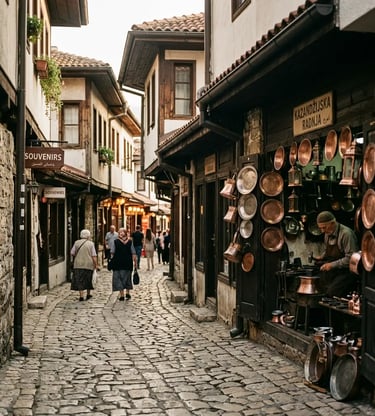
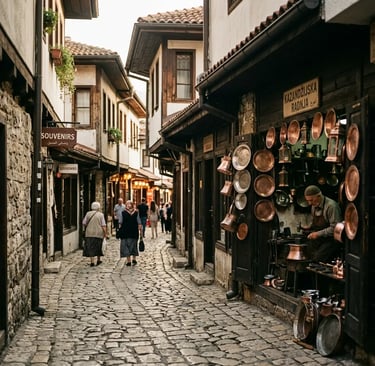
Guided Balkan tours place you inside environments your nervous system was never trained to predict. The region's layered history Ottoman, Habsburg, Yugoslav, modern creates a density of unfamiliar stimuli that disables your brain's autopilot function.
When autopilot disengages, you process reality in real time. That state is where actual learning, recalibration, and self-awareness occur. Atlas Global Tours engineered a 10-day route from Budapest to Kotor that sequences these pattern disruptions deliberately.
What Does the Budapest to Kotor Tour Actually Cover?
The itinerary begins on the Danube River in Budapest, where the weight of Buda Castle above the waterline communicates something your ancestor brain registers before your conscious mind catches up — strategic elevation, defendable terrain, civilizational permanence.
From Budapest, the route descends into Belgrade. Kalemegdan Fortress sits at the confluence of the Danube and Sava rivers, a site fortified and destroyed over 100 times. Standing there recalibrates your internal scale for what "difficulty" actually means.
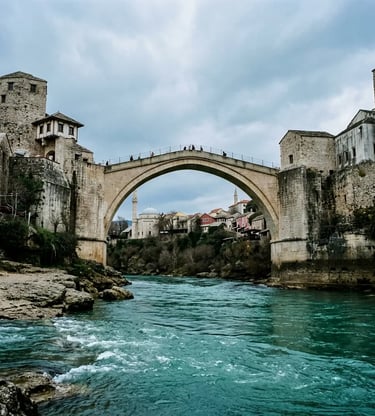
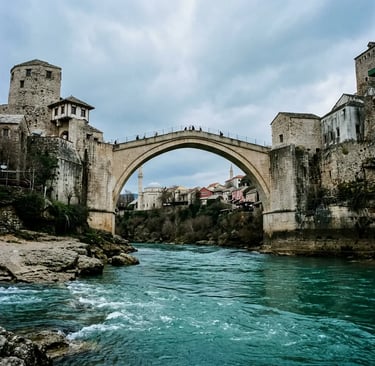
The itinerary then moves through Sarajevo, a city that metabolized siege and rebuilt without erasing the scars. Next, Mostar Bridge reconstructed after its 1993 destruction — functions as a physical metaphor for resilience that your limbic system reads faster than any self-help book.
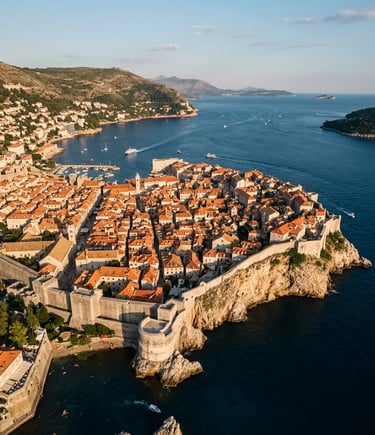
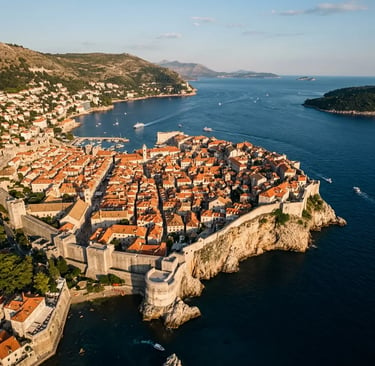
The Croatian coast delivers Diocletian's Palace in Split, a Roman emperor's retirement compound now functioning as a living neighborhood. Dubrovnik follows, where UNESCO World Heritage sites in the Balkans become tangible infrastructure rather than abstract designations.
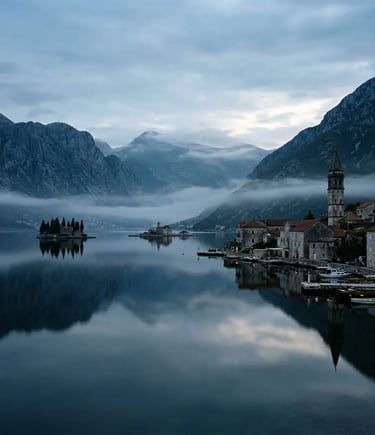
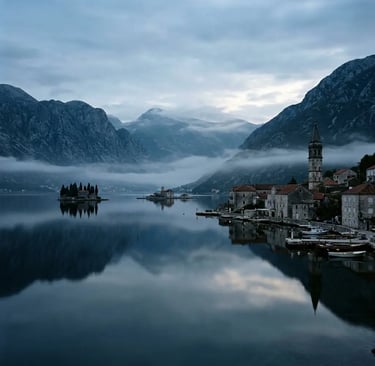
The journey terminates at the Bay of Kotor in Montenegro a fjord-like inlet surrounded by medieval fortifications that your body interprets as arrival at a defensible home base.
Who Is This Balkans Itinerary 10 Days Designed For?
It is not designed for people seeking confirmation of what they already believe. Atlas Global Tours built this route for individuals who recognize that environment dictates cognition, and cognition dictates outcomes.
If your operating environment has been the same office, the same city, the same feedback loops for years, your pattern library is stale. The Balkans force a firmware update your system cannot get from another resort town.
What Makes Atlas Global Tours the Correct Operator?
Logistics in the Balkans involve six countries, multiple border crossings, and infrastructure that varies sharply between capitals. Atlas Global Tours eliminates the friction of navigation so your cognitive bandwidth stays allocated to absorption rather than problem-solving transit schedules.
The operator handles sequencing. You handle integration.
TL;DR Key Takeaways
A Budapest to Kotor tour through the Balkans is a 10-day neurological pattern interrupt, not a standard holiday.
The route passes through Budapest, Belgrade's Kalemegdan Fortress, Sarajevo, Mostar Bridge, Diocletian's Palace, Dubrovnik, and the Bay of Kotor each site selected for its historical and cognitive density.
Guided Balkan tours with Atlas Global Tours remove logistical friction across six countries so bandwidth is preserved for experiential processing.
UNESCO World Heritage sites in the Balkans function as physical evidence of civilizational resilience — data your nervous system absorbs without conscious effort.
The standard European vacation reinforces existing scripts. This Balkans itinerary 10 days disrupts them at the root level.
Your ancestor brain already knows the difference between simulation and terrain. Stop touring. Start operating.
Frequently Asked Questions About the Budapest to Kotor Balkan Tour
Is a 10-Day Balkans Itinerary Enough Time to Cover Budapest to Kotor?
Ten days is the operationally correct duration for this specific route. Atlas Global Tours calibrated the sequencing so each destination receives enough exposure time for genuine cognitive absorption without triggering decision fatigue or stimulus saturation.
Shorter itineraries force surface-level consumption. You photograph Buda Castle, glance at the Danube River, and move on before your nervous system registers anything beyond a visual snapshot. That is data collection without processing the behavioral equivalent of reading a book by flipping through pages.
The 10-day structure allocates time for what behavioral scientists call "dwell processing" the period after initial exposure where pattern recognition deepens and environmental data integrates into long-term cognitive frameworks. Each stop from Kalemegdan Fortress to the Bay of Kotor is spaced to allow this integration window.
Are UNESCO World Heritage Sites in the Balkans Worth Prioritizing Over Western Europe?
UNESCO World Heritage sites in the Balkans carry a fundamentally different informational payload than their Western European counterparts. Sites like Diocletian's Palace in Split and the Old Town of Dubrovnik are not preserved behind velvet ropes. They function as living infrastructure where residents conduct daily life inside ancient walls.
Western European heritage sites have been optimized for passive consumption. They are spectator environments. Balkan heritage sites remain participant environments you walk through Mostar Bridge alongside locals crossing it for groceries, not alongside tour groups following numbered audio stops.
This distinction matters at a neurological level. Participant environments activate mirror neuron networks and spatial reasoning circuits simultaneously. Spectator environments activate only visual processing. The depth of encoding is measurably different, and the Balkans deliver the deeper version without artificial staging.
What Makes Guided Balkan Tours Safer Than Independent Travel?
The Balkans involve six sovereign nations with distinct border protocols, variable road infrastructure, and language shifts that occur every few hundred kilometers. Independent navigation consumes cognitive bandwidth that guided Balkan tours with Atlas Global Tours deliberately preserve for experiential intake.
Safety in this context is not about physical danger. The region is statistically secure for travelers. Safety here refers to operational efficiency eliminating the micro-decisions around currency exchange, transit scheduling, accommodation verification, and route optimization that accumulate into what psychologists classify as decision fatigue.
Atlas Global Tours functions as your logistical prefrontal cortex on this route. Border crossings between Hungary, Serbia, Bosnia, Croatia, and Montenegro are pre-managed. Accommodation sequencing is locked. Your only operational task is to remain cognitively present at each site, from the fortress walls of Belgrade to the fjord-like stillness of the Bay of Kotor.
How Does a Budapest to Kotor Tour Compare to a Standard Mediterranean Vacation?
A standard Mediterranean vacation operates on a predictability loop. The resort model, the beach model, the curated old-town walking tour model these are socially scripted experiences engineered to minimize surprise. Your brain enters energy-conservation mode within 48 hours because nothing in the environment challenges its existing pattern library.
A Budapest to Kotor tour reverses this mechanism entirely. The environmental texture shifts every 24 to 48 hours — from the Austro-Hungarian grandeur of Budapest to the Ottoman layering of Sarajevo to the Venetian coastal architecture of Dubrovnik. Each transition forces your perceptual systems to rebuild contextual frameworks from scratch.
The downstream behavioral effect is significant. Travelers returning from predictability-based vacations report baseline reversion within three to five days. Travelers returning from high-density pattern-disruption itineraries like this Balkans route report sustained shifts in decision-making clarity, stress tolerance, and environmental awareness for weeks. The Balkans do not offer relaxation. They offer recalibration.
Connect
Join us for travel tips and destination insights.
© 2026. All rights reserved.
Affiliate disclaimer
This website contains affiliate links. If you purchase through these links, we may earn a commission at no extra cost to you.