
4 Day Croatia Bosnia Slovenia Itinerary: The Ultimate Private Tour from Dubrovnik to Zagreb
Plan the perfect 4 day Croatia Bosnia Slovenia itinerary: Dubrovnik, Mostar, Split, Zadar, Plitvice Lakes, Lake Bled, Ljubljana & Zagreb. Day-by-day route, insider tips, costs & why a private tour beats DIY every time.
ITINERARIES (48–72H)
DestinationDiscover
3/12/202612 min read
Affiliate Disclosure
This article contains affiliate links. If you purchase through these links, I may earn a small commission at no extra cost to you. I only recommend products I genuinely believe offer strong performance, quality, and value for your ski and travel experience.
The Balkans in 4 days. Sounds impossible. Until you see the route.
The Trip Nobody Thinks Is Possible (Until They Do It)
Most people spend months planning a Balkans trip and still miss half of what makes it extraordinary. They book wrong, drive long, queue forever, and arrive at Plitvice at noon on a Tuesday in August shoulder-to-shoulder with 3,000 strangers.
This 4 day Croatia Bosnia Slovenia itinerary is different.
It's built around a single, ruthlessly efficient private route: Dubrovnik → Mostar → Split → Zadar → Plitvice Lakes → Lake Bled → Ljubljana → Zagreb. Eight destinations. Four days. Zero wasted hours. And if you do it right — with a private guide, an early start, and insider timing you will see sides of the Balkans that most tourists never find.
This is not a backpacker itinerary. This is not a bus tour. This is the Balkans the way it deserves to be experienced: on your terms, at your pace, with someone who knows exactly where to stop, what to skip, and which restaurant the locals actually eat at.
Let's build your trip.


Why This Route Works (And Most Don't)
The Balkans suffer from what travel planners call the proximity trap everything looks close on a map until you're stuck behind a campervan on a mountain road in Bosnia with no phone signal and a 3-hour border crossing ahead of you.
This route solves that problem by running north-south along the Adriatic coast before cutting inland through Bosnia and then sweeping up through Slovenia following the natural geography, not fighting it.
The full route at a glance:
Dubrovnik → Mostar → Split → Zadar → Plitvice Lakes → Lake Bled → Ljubljana → Zagreb
Total distance: approximately 1,050 km. Done properly: four unforgettable days.
Day 1: Dubrovnik to Mostar to Split
From Game of Thrones walls to Ottoman bridges to Venetian palaces in one day.
Morning: Dubrovnik (Early Start Is Everything)
If you arrive in Dubrovnik the night before which we strongly recommend wake up before 7am and walk the city walls before the cruise ships dock.
By 8am, the old town is yours. The limestone streets catch the early light in a way that photographs can't quite capture. The walls of King's Landing yes, this is where much of Game of Thrones was filmed glow amber against the Adriatic blue.
By 10am, those same streets will be packed with day-trippers. The window is real, and short.
What to see:
Walk the city walls (2km loop, unbeatable views)
Stradun, the main limestone boulevard
Fort Lovrijenac the cliff fortress locals call "Dubrovnik's Gibraltar"
Lokrum Island view from the harbor
Insider tip: Skip the cable car if time is tight. The walls give you better views and they're included in the old town access.
Midday: Cross into Bosnia Mostar
Here is the moment where most itineraries lose people. The border crossing into Bosnia & Herzegovina at Neum sounds intimidating. With a private guide who crosses it weekly, it takes under 20 minutes.
Then comes Mostar and it will stop you cold.
The Stari Most (Old Bridge) arches over the turquoise Neretva River like something from a fever dream. It was destroyed during the 1993 Bosnian War and painstakingly rebuilt stone by stone, reopening in 2004. Standing on it, knowing its history, changes something in you.
The old bazaar Kujundžiluk is narrow, chaotic, and genuinely beautiful. Copper craftsmen still work in the same doorways they always have. The call to prayer echoes across rooftops.
What to see:
Stari Most (Old Bridge) walk it, photograph it, understand it
Kujundžiluk bazaar
Koski Mehmed Pasha Mosque (for the minaret view)
The Blagaj Tekke a 16th-century Dervish monastery built into a clifftop spring if time allows
Insider tip: Lunch in Mostar. Order ćevapi small grilled sausages in flatbread with raw onion and kajmak cream. The place with no English sign usually has the best food.
Evening: Arrive Split
Two hours north of Mostar, Split surprises people who think it's just a transit city for island ferries.
Check in, drop your bags, and walk directly into Diocletian's Palace a Roman emperor's retirement home that has been continuously inhabited for 1,700 years. People live inside a Roman palace. There are bars inside a Roman palace. There is a jazz festival inside a Roman palace.
Dinner on the Riva waterfront promenade as the sun drops into the Adriatic. This is the life.
Day 2: Split → Zadar → Plitvice Lakes
Waterfalls, sea organs, and the most photographed lakes in Europe before anyone else arrives.
Morning: Split Old Town
If you have a morning in Split before heading north, use it well.
Peristyle square the Roman courtyard at the heart of the palace
Cathedral of Saint Domnius (built inside a Roman mausoleum only in the Balkans)
The Golden Gate best-preserved of the four palace entrances
Meštrović Gallery if you care about Croatian sculpture
Insider tip: The Pazar open market just outside the palace walls is where locals shop. Better coffee, better prices, better people-watching than anything on the tourist circuit.
Midday: Zadar The Sea Organ
Ninety minutes north of Split, Zadar is criminally undervisited.
Alfred Hitchcock once called its sunsets the most beautiful in the world. The Sea Organ 35 pipes built into marble steps along the waterfront plays music using nothing but wave energy. The Sun Salutation installation next to it converts solar energy into a light show after dark.
But the old town a Roman grid within medieval walls, with churches built on top of ancient temples is what makes Zadar unforgettable.
What to see:
Church of St. Donatus (built on a Roman forum)
The Sea Organ
The Sun Salutation
Forum ruins
Five Wells Square
Insider tip: Stay for the sunset if your schedule allows. Hitchcock wasn't wrong.
Afternoon/Evening: Plitvice Lakes
Here is the critical move in this itinerary: arrive at Plitvice Lakes in the late afternoon.
Every tour group arrives at 10am. The trails are like a conveyor belt. The famous turquoise water is framed by selfie sticks.
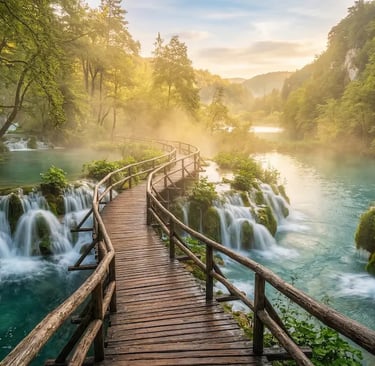
Arrive at 4pm. The light slants through the beech and fir trees at a low angle, turning the travertine waterfalls golden. The crowds have thinned. The water 16 shades of blue and green depending on the minerals, the microorganisms, and the angle of the sun does what it does best when there's space to actually see it.
Stay the night near the park. The evening is yours.
What to see:
Lower Lakes Circuit (2–3 hours, the most dramatic waterfalls)
The famous boardwalk over the water genuinely otherworldly
Upper Lakes if time and energy allow
Insider tip: Swimming is prohibited (and enforced) but the boardwalk literally floats over the water. You are inside the waterfall system. That's enough.
Day 3: Plitvice → Ljubljana → Lake Bled
From Croatian wilderness to Austro-Hungarian elegance to an Alpine postcard.
Morning: Cross Into Slovenia Ljubljana
The drive north from Plitvice into Slovenia is one of the quiet pleasures of this route. The landscape shifts Adriatic scrub gives way to Alpine meadows, the light changes, the air cools.
Ljubljana, Slovenia's capital, is what every city secretly wishes it were: small enough to walk everywhere, beautiful enough to make you stop constantly, and relaxed enough that nobody is rushing.
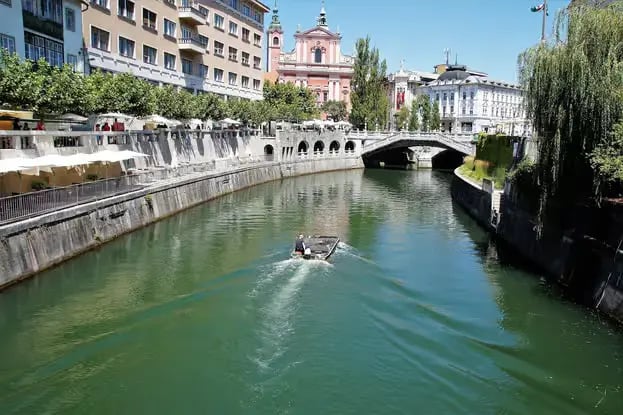
The old town spreads below Ljubljana Castle on a low hill. The Triple Bridge, Dragon Bridge, the Central Market all within 10 minutes of each other. The Ljubljanica River winds through it all.
What to see:
Ljubljana Castle (funicular or walk up)
Triple Bridge and Prešeren Square
Dragon Bridge
Central Market and Plečnik's Arcades
Metelkova a former military compound turned alternative arts district
Insider tip: Ljubljana has a serious café culture. Sit down at a riverside terrace for coffee and watch the city work. Nobody rushes in Ljubljana. Let yourself be affected by that.
Afternoon: Lake Bled
Forty-five minutes from Ljubljana, Lake Bled is there's no other word absurd.
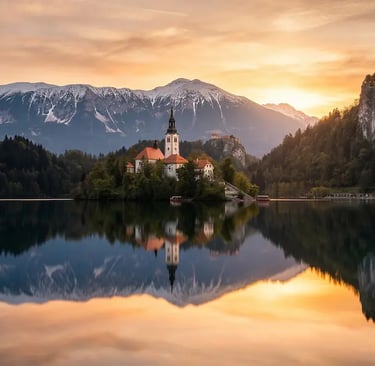
A glacial lake. An island with a church on it. A cliff with a medieval castle above. The Julian Alps as a backdrop. It looks like a desktop wallpaper someone forgot to replace with reality.
The pletna a traditional flat-bottomed wooden boat, hand-crafted and hand-rowed takes you to Bled Island. Climb the 99 steps to the church, ring the wishing bell, look back at the castle on the cliff.
Then have a kremšnita the famous Bled cream cake at the Park Hotel café. Flaky pastry, vanilla custard, whipped cream. Not negotiable.
What to see:
Bled Island (pletna boat trip)
Bled Castle (sunset views)
Vintgar Gorge if time allows wooden boardwalks over a river canyon, 4km round trip
Ojstrica viewpoint the best lake view, 20-minute hike
Insider tip: The postcard shot everyone chases is from Ojstrica viewpoint, not from the lakeshore. Most tourists never find it. Your guide will take you there.
Stay in Bled for the night. The morning light on the lake empty and still before the day-trippers arrive is worth getting up for.


Day 4: Lake Bled → Zagreb
The grand finale: a capital city that rewards the slow traveler.
Morning: Bled at Dawn
This is the payoff for staying the night.
Set your alarm for 6am. Walk to the lake. Watch the mist rise off the water as the mountains catch the first light. Not a soul around.
You've earned this.
Midday Drive: Bled → Zagreb (2 hours)
Slovenia slides into Croatia's Zagorje region castle-topped hills, vineyard valleys, medieval fortresses visible from the highway. It looks like the set of a fantasy film.
Afternoon/Evening: Zagreb
Zagreb is the surprise of the itinerary for most people. They arrive expecting a transit city and find something warmer, stranger, and more interesting.
The Upper Town Gornji Grad is medieval: cobblestones, the Stone Gate, St. Mark's Church with its famous tiled roof, the Lotrščak Tower where a cannon fires every day at noon.
The Lower Town is Austro-Hungarian grandeur: the main square (Trg bana Jelačića), the green horseshoe of parks and museums.
And then there are the museums. Zagreb has the strangest collection of small museums in Europe: the Museum of Broken Relationships (genuinely moving), the Museum of Illusions, a collection of medieval torture instruments. The city has a sense of humor about itself that you don't find in many European capitals.
What to see:
Gornji Grad (Upper Town)
Stone Gate
St. Mark's Church
Lotrščak Tower
Dolac Market
Tkalčićeva Street for dinner
Museum of Broken Relationships
Insider tip: Tkalčićeva Street is Zagreb's social artery a pedestrian street lined with cafés and restaurants where the entire city seems to congregate on warm evenings. End your four days here, with a glass of local wine, watching Zagreb go about its life.
You've just crossed three countries, eight cities, and approximately 1,700 years of European history in four days.
What to Pack
Essentials for this route:
Clothing:
Comfortable walking shoes (cobblestones in Dubrovnik and Ljubljana will punish anything with a heel)
One layer for evenings the Adriatic coast drops at night even in summer
Light rain layer Plitvice weather changes quickly
Swimwear if visiting in summer (Adriatic stops are possible en route)
Documents:
EU/UK/US citizens do not need a visa for Croatia, Bosnia, or Slovenia but carry your passport, not just an ID card
Bosnia & Herzegovina is not in the EU: keep your passport accessible at the border
Travel insurance always, everywhere, for everything
Tech:
Download offline maps (Maps.me or Google Maps offline) mobile signal drops in parts of Bosnia and the Plitvice area
Camera with a wide-angle lens the landscapes demand it
Portable charger long driving days drain phones
Other:
Local currency: Croatian Kuna is replaced by the Euro. Bosnia uses the Convertible Mark (BAM) get some before crossing the border.
Sunscreen in summer. Seriously.
Alternative Routes and Variations
If you only have 3 days: Drop Zadar and compress the coastal section. Go Dubrovnik → Mostar → Split → Plitvice → Bled → Zagreb. It's tight. It works. You miss the Sea Organ. That's the trade.
If you have 5 days: Add a full day in Ljubljana and a morning in Vintgar Gorge. Or add an island day from Split Hvar or Brač are an hour by ferry and worth an overnight.
If you're starting from Zagreb: Run the route in reverse: Zagreb → Ljubljana → Bled → Plitvice → Zadar → Split → Mostar → Dubrovnik. This works equally well and means you fly home from Dubrovnik which many travelers prefer.
If you want to go deeper into Bosnia: Replace the direct Mostar-to-Split drive with a night in Sarajevo. The Bosnian capital Ottoman bazaar meets Austro-Hungarian boulevard meets bullet-scarred post-war architecture is one of the most complex, emotional cities in Europe. Add a day and see it.
The Question Everyone Asks
"Can I do this trip on my own?"
Yes. You can. Thousands of people do. Some have brilliant trips.
But here's what they don't tell you: the ones who remember it for the rest of their lives the ones who end up at a Mostar family restaurant with no menu because their guide knows the owner, who arrive at Plitvice at exactly the right moment as the morning mist clears, who stand at Ojstrica above Bled and see the lake in a silence that tour groups never get those are the people who stopped optimizing for independence and started optimizing for experience.
The Balkans is not a destination you conquer with a Google Maps route and a Eurail pass. It's a region with layers Ottoman, Habsburg, Yugoslav, post-war that take years to understand. A great private guide compresses those years into four days of stories told in real places.
That's what you're paying for.
Ready to Go?
This exact route Dubrovnik, Mostar, Split, Zadar, Plitvice, Bled, Ljubljana, Zagreb is available as a fully private, fully customizable tour, with a dedicated guide, private vehicle, and itinerary built around what you actually want to see.
→ See the Full 4 Day Balkans Tour Itinerary and Pricing
Limited availability in peak season. Most departures book 4–8 weeks in advance.
If you've read this far, you already know you want to go. The only question is whether you book before the dates you want are gone.
Have a question about the itinerary? Drop it in the comments below. We answer every one.
Frequently Asked Questions
Is 4 days enough for Croatia, Bosnia, and Slovenia?
Four days is tight but absolutely doable if your route is planned correctly. The key is following the natural geographic corridor from Dubrovnik north through Bosnia and up the Adriatic coast into Slovenia, rather than zigzagging between destinations. With a private guide handling logistics, border crossings, and timing, you can comfortably cover Dubrovnik, Mostar, Split, Zadar, Plitvice Lakes, Lake Bled, Ljubljana, and Zagreb without feeling rushed. What kills most DIY itineraries isn't the distance it's the wasted hours. A well-run private tour eliminates them.
Do I need a visa for Croatia, Bosnia, and Slovenia?
Citizens of the EU, UK, USA, Canada, and Australia do not need a visa for any of these three countries for short stays. However, Bosnia & Herzegovina is not an EU member state, so you will cross an international border at Neum. Carry your passport not just a national ID card and have it accessible. Border crossings on this route are routine and typically fast with an experienced driver.
What is the best time of year for this 4 day Croatia Bosnia Slovenia itinerary?
April–May and September–October are the sweet spots. Spring brings high waterfalls at Plitvice, thin crowds at Bled, and ideal temperatures across the coast. Early autumn gives you warm Adriatic weather, dramatic light, and the summer crowds gone. July and August work but require earlier starts, more advance booking, and significantly more patience at popular sites like Plitvice and Dubrovnik's city walls.
How much does a 4 day private Balkans tour cost?
For two people using a private guided tour with mid-range accommodation, budget roughly €1,400–2,200 total, including the guide, hotels, food, and entrance fees. The guide and driver typically costs €300–450 per day, which is split across however many people are in your group making it considerably more affordable for families or small groups of 3–4 travelers. Entrance fees across all sites total approximately €80–120 per person.
Is Mostar safe to visit?
Yes. Mostar is a safe and welcoming destination. The scars of the 1990s war are visible deliberately preserved in some cases as a memorial but the city is fully functioning, hospitable, and increasingly popular with travelers. The old bazaar area around Stari Most is lively and tourist-friendly. Standard travel precautions apply, as in any city.
Can I swim at Plitvice Lakes?
No. Swimming is strictly prohibited at Plitvice Lakes National Park and the rules are actively enforced. The water's extraordinary color comes from a delicate balance of minerals and microorganisms that human contact disrupts. The good news: the boardwalks run directly over and through the water system, so you are physically inside the lakes without touching them. It's genuinely immersive even without swimming.
How long is the drive between destinations on this route?
Here are the approximate driving times between each stop:
Dubrovnik → Mostar: 1.5–2 hours (including border crossing)
Mostar → Split: 1.5–2 hours
Split → Zadar: 1.5 hours
Zadar → Plitvice Lakes: 1.5 hours
Plitvice Lakes → Ljubljana: 2.5 hours
Ljubljana → Lake Bled: 45 minutes
Lake Bled → Zagreb: 2 hours
Total driving across four days: approximately 10–11 hours. Distributed across the itinerary, none of the individual legs feel long.
What currency do I need in Bosnia?
Bosnia & Herzegovina uses the Convertible Mark (BAM), not the Euro. Croatia and Slovenia both use the Euro. Withdraw some BAM before or at the border most smaller restaurants and craft shops in Mostar's bazaar are cash only and don't accept Euros. A small amount (€30–50 worth) is sufficient for a half-day visit to Mostar.
Why is a private tour better than a group bus tour for this itinerary?
Three reasons that matter in practice. First, timing: a private guide can get you to Plitvice Lakes and Dubrovnik at exactly the right time to avoid peak crowds bus tours cannot flex their schedule. Second, access: private guides have local relationships that open doors family restaurants, hidden viewpoints, faster border crossings. Third, the experience itself: you spend four intense days with the same person, who can read what you love and adjust the route accordingly. A bus tour cannot do any of those three things.
Can this itinerary be done in reverse, starting from Zagreb?
Yes the route works equally well in both directions. Starting from Zagreb and ending in Dubrovnik is a popular choice for travelers who prefer to fly home from Dubrovnik's airport or who want to save the Adriatic coast as a grand finale. The driving times and logistics are identical; only the sequence changes.
Connect
Join us for travel tips and destination insights.
© 2026. All rights reserved.
Affiliate disclaimer
This website contains affiliate links. If you purchase through these links, we may earn a commission at no extra cost to you.